Sonder Meaning: Realizing Every Stranger Has a Vivid Life
You walk through a crowd, seeing faces but not lives. Each person you dismiss is the main character of their own epic, yet you remain blind to it. Understanding the sonder meaning changes that, awakening a profound empathy for every stranger’s hidden world.
Sonder at a Glance
| Aspect | Detail |
| Term | Sonder |
| Pronunciation | son-der |
| Part of Speech | Noun |
| Coined by | John Koenig |
| First Appeared | 2012 (online), published in The Dictionary of Obscure Sorrows (2021) |
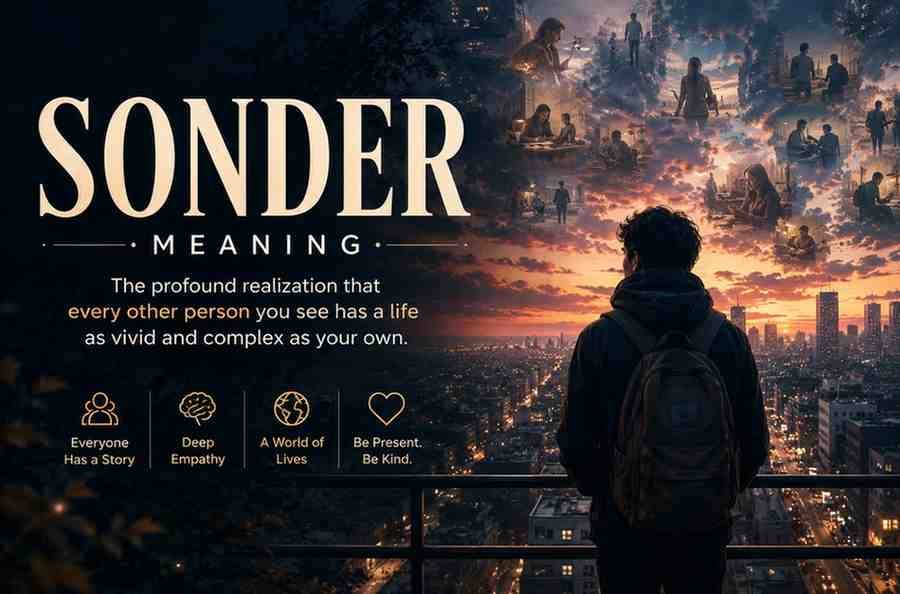
| Sonder Meaning | The sudden realization that every passerby lives a life as vivid, complex, and emotionally rich as your own |
What Exactly Is the Sonder Meaning?
The sonder meaning captures a flash of awareness you feel when you truly see a stranger. You realize that the man waiting at the crosswalk isn’t just background noise. He mourns private losses, celebrates small victories, and carries a constellation of memories you will never touch. That brief, piercing insight—that every other person is the protagonist of their own sprawling story—is the heart of the sonder meaning.
Psychologists describe this as a shift from an egocentric viewpoint to an allocentric one. You stop treating people as extras in your movie and recognize them as full human beings. John Koenig, who coined the term, defines it as “the realization that each random passerby is living a life as vivid and complex as your own” (Koenig, 2021). The sonder meaning hits without warning, often in crowded spaces, and leaves a bittersweet ache.
The Origin of the Word Sonder
Sonder didn’t grow from ancient roots. It appeared in the early 2010s on the blog The Dictionary of Obscure Sorrows, where John Koenig invents words for emotions that lack names. He borrowed the German prefix sonder- (as in Sonderzug, special train) and the French sonder (to probe or sound out) to craft a term that feels both intimate and expansive. The sonder meaning resonated so deeply that the word spilled out of niche internet circles into mainstream conversation, eventually landing in the 2021 book The Dictionary of Obscure Sorrows.
Who Coined Sonder and Why?
John Koenig created the word to fill a gap. He noticed that no single English word captured the jolt of recognizing the inner lives of strangers. Existing terms like empathy or compassion danced around the idea but never landed on that precise, startling moment of realization.
The sonder meaning, as Koenig shaped it, gives people a vocabulary for a universal but previously nameless experience. In his 2016 TED Talk, he explained that naming these emotions helps us feel less alone and more connected to the human project.
The Emotional Experience of Sonder
When you grasp the sonder meaning, a quiet wave washes over you. Your chest tightens. Your inner monologue stalls. For a few seconds, the boundary between self and other thins.
You see the elderly woman at the bus stop not as a stranger but as someone who once fell in love, who cried on a kitchen floor, who laughed until her ribs hurt. That recognition stirs awe, tenderness, and a gentle sadness—sadness because you know you will never hear her stories. This fleeting ache is what makes the sonder meaning so unforgettable.
Sonder Meaning vs. Empathy: The Nuanced Difference
| Feature | Sonder | Empathy |
| Focus | Awareness of another’s full, complex existence | Sharing or understanding another’s emotions |
| Trigger | Observing a stranger, often from a distance | Direct interaction or witnessing distress |
| Feeling Tone | Awe, bittersweet wonder | Warmth, concern, sometimes distress |
| Scope | The entirety of a life story | A specific emotional state |
Empathy says, “I feel your pain.” The sonder meaning says, “I suddenly grasp that you have a whole life I’ll never know.” You can experience sonder without feeling what the other person feels. A driver in the next car might be singing to a song you can’t hear, and the sonder meaning sweeps in—you understand he’s the center of his own universe, even if you never exchange a glance.
How Sonder Changes Your Perspective on Daily Life
Once you absorb the sonder meaning, ordinary spaces transform.
- A crowded subway car becomes a mosaic of hidden biographies.
- A checkout line morphs into a row of parallel narratives.
- A passing cyclist carries an invisible backpack of joys and regrets.
You stop reducing people to roles—barista, commuter, stranger—and start wondering about their favorite meals, their childhood fears, the last thing that made them genuinely laugh. This mental shift chips away at loneliness and softens judgment. The sonder meaning reminds you that the world is impossibly deep, and you are one thread in a giant tapestry.
Real-Life Examples of Sonder in Action
Picture these moments:
- You look through an airplane window and spot a distant town. Hundreds of glowing windows. Inside each, someone is arguing, kissing a child goodnight, reheating leftovers, staring at a ceiling. You feel the sonder meaning crash in.
- You scroll past a stranger’s social media profile. Their photos show birthday parties and beach trips. You realize their private grief never makes the grid. The sonder meaning hits.
- You watch a janitor mop a hallway late at night. His shoulders slump. You don’t know his name, but you know he has a reason for working that shift—a daughter’s tuition, a sick parent, a dream he put on hold. That knowing is the sonder meaning in action.
The Psychology Behind Realizing Others’ Inner Worlds
Cognitive scientists call the ability to understand that other minds contain different thoughts, beliefs, and emotions “theory of mind.” The sonder meaning takes theory of mind and supercharges it with emotional weight.
Instead of intellectually noting that others have minds, you feel the vastness of those minds. Research on perspective-taking shows that deliberately imagining the inner life of a stranger increases altruism and reduces bias (Zaki, 2019). The sonder meaning works the same way, but often arrives spontaneously, without effort.
Sonder in Art, Music, and Literature
Artists have circled the sonder meaning for centuries, even before the word existed. Edward Hopper’s paintings isolate figures in diners and hotel rooms, inviting you to invent their stories. The band The Postal Service’s song “The District Sleeps Alone Tonight” paints a city full of unseen narratives.
Haruki Murakami’s novels frequently pause to imagine the inner lives of minor characters. Koenig’s coinage gave these scattered explorations a shared name, and now the sonder meaning threads through movies, poetry, and photography that celebrate hidden human complexity.
Why Recognizing Sonder Can Improve Mental Health
Feeling the sonder meaning can lift your mood in subtle ways.
- It reduces self-absorption by pulling your attention outward.
- It reminds you that your problems are just one strand in a vast human web, easing feelings of isolation.
- It fosters gratitude for the brief, beautiful connections you do get to make.
Clinical psychologists often encourage gratitude journaling and perspective-taking exercises that mirror the spontaneous mechanism of the sonder meaning. When you intentionally notice the fullness of strangers’ lives, you train your brain toward compassion and away from rumination.
Practical Ways to Cultivate Sonder Every Day
You don’t have to wait for the sonder meaning to strike by chance. You can practice it.
- People-watch with intention. Sit in a café and pick one person. Imagine their morning, their worries, their favorite song.
- Use commute time. On the bus, silently narrate a mini-biography for a rider you’ve never met.
- Write a letter you’ll never send. Address it to a stranger you glimpsed and describe the life you imagine for them.
- Reflect on photographs. Look at old group photos from decades ago and realize each face held a universe.
- Practice “just like me” meditation. Silently note, “This person has loved, lost, and hoped, just like me.”
These small rituals weave the sonder meaning into your daily routine, turning fleeting realizations into a lasting orientation.
The Connection Between Sonder and Mindfulness
Mindfulness teaches you to notice the present moment without judgment. The sonder meaning is a focused, outward-directed mindfulness. When you stand in a crowd and absorb the reality of all those parallel lives, you’re deeply anchored in the here and now.
You’re not scrolling through your phone or rehearsing a past argument. You’re awake to the world’s richness. Integrating the sonder meaning with mindfulness practice can deepen both, creating a sense of grounded wonder.
Sonder Meaning in the Age of Social Media
Social media offers a distorted lens on the sonder meaning. You scroll through hundreds of profiles, aware that each represents a full life, yet the algorithm flattens those lives into highlight reels. The platform design encourages quick reactions, not deep reflection.
Still, moments of genuine sonder break through—a stranger’s raw post about grief, a candid photo that captures private joy. To protect the sonder meaning in the digital age, slow your scroll. Pause. Remember the messy, unposted reality behind every curated square.
Common Misconceptions About Sonder
- Misconception 1: Sonder is just empathy.
Empathy focuses on shared feeling; the sonder meaning is about the shock of recognizing the scope of another’s experience. - Misconception 2: Sonder is always sad.
It can be melancholic, but it’s also beautiful and humbling—a reminder of how much life surrounds you. - Misconception 3: Sonder requires large crowds.
You can experience the sonder meaning seeing a single lit window from a train or hearing a distant laugh through an apartment wall.
Why Sonder Is More Than Just a Passing Thought
The sonder meaning doesn’t just decorate your mind for a few seconds. It rewires how you relate to others. People who regularly feel this awareness report greater patience, less road rage, more curiosity, and a deeper sense of belonging.
When you genuinely believe that every person you encounter carries a story as intricate as yours, you become kinder—not because you “should,” but because you can’t ignore their humanity. That shift fuels stronger communities, more authentic conversations, and a life that feels larger than your own concerns.
Frequently Asked Questions About the Sonder Meaning
What is the sonder meaning in simple terms?
The sonder meaning is the sudden realization that every stranger you see lives a life just as deep, emotional, and eventful as yours.
Who created the word sonder?
Writer and neologist John Koenig coined the term for his project The Dictionary of Obscure Sorrows, later published as a book in 2021.
How is sonder different from empathy?
Empathy involves sharing another’s feelings. The sonder meaning is the startling awareness of the vast inner world of a passerby, without necessarily feeling what they feel.
Why does sonder feel so overwhelming?
It temporarily dismantles your self-centered perspective and floods you with the sheer scale of human experience, which can feel both awe-inspiring and humbling.
Can you experience sonder while alone?
Absolutely. Reflecting on old photographs, hearing distant voices, or reading someone’s obituary can trigger the sonder meaning just as powerfully as standing in a crowd.
How can I practice sonder daily?
Pause during routine moments—waiting in line, sitting at a red light—and vividly imagine the personal history, dreams, and struggles of one unknown person nearby.