What Is a Catalyst Meaning? Types & Real-World Examples
You’re trying to spark a change—whether in a chemical reaction, your team’s productivity, or your personal growth—but progress stalls. The missing piece is often invisible. A catalyst meaning goes beyond a simple definition; it’s the agent that accelerates transformation without getting used up. This guide explores catalyst meaning across disciplines and gives you the tools to apply it.
Catalyst Meaning: A Clear Definition
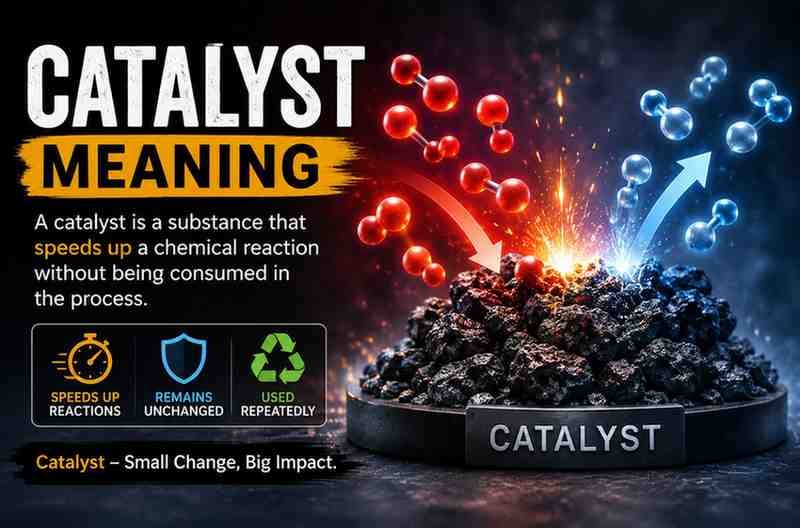
The catalyst meaning can be summed up as a substance, person, or event that speeds up a process while remaining unchanged at the end. In strict scientific terms, a catalyst increases the rate of a reaction by lowering the activation energy. It participates without permanent alteration. The IUPAC Gold Book defines a catalyst as “a substance that increases the rate of a reaction without modifying the overall standard Gibbs energy change in the reaction.”¹
In everyday language, the catalyst meaning extends to people or events that ignite change. A leader who transforms a stagnant team, a conversation that sparks a new idea—these act as human catalysts. The core principle stays the same: you add something that makes things happen faster, and it comes out whole on the other side.
The Origin and Etymology of the Word Catalyst
The word “catalyst” comes from the Greek katalusis, meaning “dissolution.” It entered English in the early 20th century as chemistry advanced. Originally tied to laboratory reactions, the term soon bled into social sciences and business. Today, understanding the catalyst meaning requires seeing both its scientific root and its broader human application.
How a Catalyst Works: The Science of Lowering Activation Energy
Every chemical reaction needs a minimum energy bump to get started—called activation energy. An alternate route with a reduced energy barrier is offered by a catalyst. Imagine pushing a boulder over a hill. Without help, you need to push it over a steep peak. A catalyst reshapes the hill into a gentle slope. The boulder still reaches the other side, but you use far less effort. The catalyst itself remains unchanged, ready to help the next boulder.
This process appears in industrial synthesis, food digestion, and even in the way habits form. The catalyst meaning remains consistent: it’s the enablement of faster progress without being consumed.
Types of Catalysts: Homogeneous, Heterogeneous, and Biocatalysts
No matter the type, the catalyst meaning stays rooted in acceleration without self-destruction. Catalysts split into three main categories.
- Homogeneous catalysts occupy the same phase (usually liquid) as the reactants. One well-known example is ester hydrolysis catalyzed by acid.
- Heterogeneous catalysts exist in a different phase, typically solid catalysts with liquid or gas reactants. Your car’s catalytic converter uses rhodium and platinum on a solid honeycomb.
- Biocatalysts are nature’s enzymes. They drive every metabolic reaction, from breaking down starch to replicating DNA.
Table: Catalyst Types at a Glance
| Catalyst Type | Phase Relationship | Common Examples | Key Application |
| Homogeneous | Same phase as reactants | Sulfuric acid in esterification | Chemical manufacturing |
| Heterogeneous | Different phase | Iron in ammonia synthesis, catalytic converters | Fuel production, emission control |
| Biocatalyst | Aqueous cellular environment | Amylase, DNA polymerase | Digestion, genetic replication |
Catalyst Meaning in Chemistry: Everyday Reactions
In chemistry, the catalyst meaning is strictly defined by rate enhancement and zero net consumption. Consider the decomposition of hydrogen peroxide. Left alone, it breaks down slowly. Add a pinch of manganese dioxide, and it foams instantly as oxygen rushes out. The manganese dioxide remains unchanged. The American Chemical Society highlights that over 90% of chemical manufacturing processes rely on catalysts to save energy and raw materials.²
Iron catalysts in the Haber-Bosch process produce ammonia for fertilizer, feeding billions. Zeolite catalysts crack crude oil into gasoline. These industrial giants embody the same simple catalyst meaning: they make difficult reactions practical.
Catalyst Meaning in Biology: Enzymes and Life Processes
This biological catalyst meaning shows up in every heartbeat and thought. Enzymes are protein-based biocatalysts with extraordinary specificity. Lactase breaks down milk sugar; catalase protects your cells by splitting hydrogen peroxide into water and oxygen. Each enzyme lowers the activation energy for a single reaction, making life’s chemistry possible at body temperature.
Without enzymes, reactions that sustain you would require boiling heat or corrosive extremes. The catalyst meaning here underscores nature’s elegance: a reusable tool that never wears out from the work it does.
Catalyst Meaning in Business and Leadership
The catalyst meaning in a corporate context describes a person, strategy, or tool that accelerates growth, innovation, or culture change without being drained by the process. A catalytic leader asks the right questions, removes obstacles, and creates momentum—then steps back so the team owns the result.
Jonah Berger, in his book The Catalyst, outlines how effective change agents reduce barriers rather than push harder.³ They identify the psychological or structural friction and dissolve it. A project manager who streamlines approval workflows acts as an organizational catalyst. The result: faster delivery and a reusable system.
Real-world company turnarounds often point to a catalytic event—a new product launch, a strategic hire, or a shift in market positioning that permanently speeds up growth. The catalyst meaning here translates directly to leverage points that transform output without draining the catalyst.
Personal Development: How to Be a Catalyst in Your Own Life
Personal catalyst meaning focuses on actions that accelerate your growth without exhausting your identity. Building a morning routine that triggers productive momentum is a catalyst. A single conversation that reframes your limiting belief works the same way.
To become a catalyst for yourself:
- Identify the activation energy blocking your goal.
- Introduce a small, repeatable ritual that lowers that barrier.
- Observe the change while you remain grounded and unspent.
A five-minute journaling habit can catalyze clarity. A brief walk before deep work lowers mental resistance. You’re not consuming yourself; you’re engineering conditions for faster, sustainable progress.
Everyday Examples of Catalysts Around You
You encounter catalysts constantly. The catalytic converter in your vehicle transforms toxic carbon monoxide and nitrogen oxides into safer gases. Bread rises because enzymes in yeast catalyze the breakdown of starches into sugars and carbon dioxide. Even the self-cleaning function of an oven uses a catalyst-coated surface to oxidize food residue at lower temperatures.
Each of these examples affirms the same catalyst meaning: a helper that speeds change and emerges ready to work again.
Catalyst vs. Inhibitor: Opposite Forces
An inhibitor does the reverse—it raises activation energy or blocks the catalyst’s active site. While a catalyst speeds the journey, an inhibitor slams the brakes. In the body, some drugs act as enzyme inhibitors to slow disease processes. In teams, a toxic behavior pattern acts as a social inhibitor. Understanding the catalyst meaning helps you diagnose both accelerators and blockers in any system.
How to Identify a Catalyst in Any System
Ask three questions to find the catalyst:
- What speeds up once this element appears?
- Does this element remain unchanged after the outcome?
- Can the effect be repeated without replenishing the element?
If the answers are yes, you’ve found your catalyst. This mental model applies to reactions, business processes, and personal breakthroughs alike.
The Role of a Catalyst in Habit Formation
Habits rely on cues that lower the activation energy for a behavior. A visible fruit bowl catalyzes healthier eating. A dedicated workspace signals the brain to enter deep focus. The catalyst meaning here merges psychology with chemistry: you redesign your environment so the desired action requires less effort each time. The cue remains constant, just like a solid catalyst, ready for the next cycle.
Common Misconceptions About Catalyst Meaning
A widespread misunderstanding of catalyst meaning is that catalysts change the final balance of a reaction or make the impossible possible. They don’t alter thermodynamics or the equilibrium position. They only reduce the time to reach that state. Another myth: catalysts work forever. In reality, they can be poisoned or fouled by impurities, though under ideal conditions they last through many cycles.
Applying Catalyst Principles to Speed Up Results
Use the catalyst framework to solve problems:
- Map the current speed-limiting step.
- Design a reusable intervention that lowers the barrier.
- Test and refine without overcomplicating.
A sales team struggling with low conversion can introduce a standardized needs-discovery script as a catalyst. The script remains intact; the team’s performance accelerates. This approach scales across contexts because it respects the simple, powerful catalyst meaning.
Frequently Asked Questions About Catalyst Meaning
What is the simple meaning of a catalyst?
In simple terms, the catalyst meaning is a substance or person that speeds up a process without being permanently altered. It makes change happen faster and remains ready to work again.
How does a catalyst speed up a reaction without being consumed?
It provides an alternative pathway with lower activation energy. It participates in intermediate steps but regenerates fully by the end, so its net structure stays unchanged.
Can a person be a catalyst?
Absolutely. A person acts as a catalyst when their words or actions ignite transformation in others or in a system, yet they don’t lose their own energy or identity in the process.
What is the difference between a catalyst and an enzyme?
An enzyme is a specific type of biological catalyst made of protein. All enzymes are catalysts, but not all catalysts are enzymes. The catalyst meaning covers both synthetic and natural agents.
What are common industrial catalysts used today?
Iron in ammonia synthesis, platinum-rhodium in catalytic converters, zeolites in petroleum cracking, and nickel in hydrogenation are among the most widely used industrial catalysts.
Why is catalyst meaning important in personal growth?
It shifts your focus from forceful effort to strategic leverage. You stop trying to grind through resistance and start introducing reusable habits and mindsets that accelerate progress without burning out.