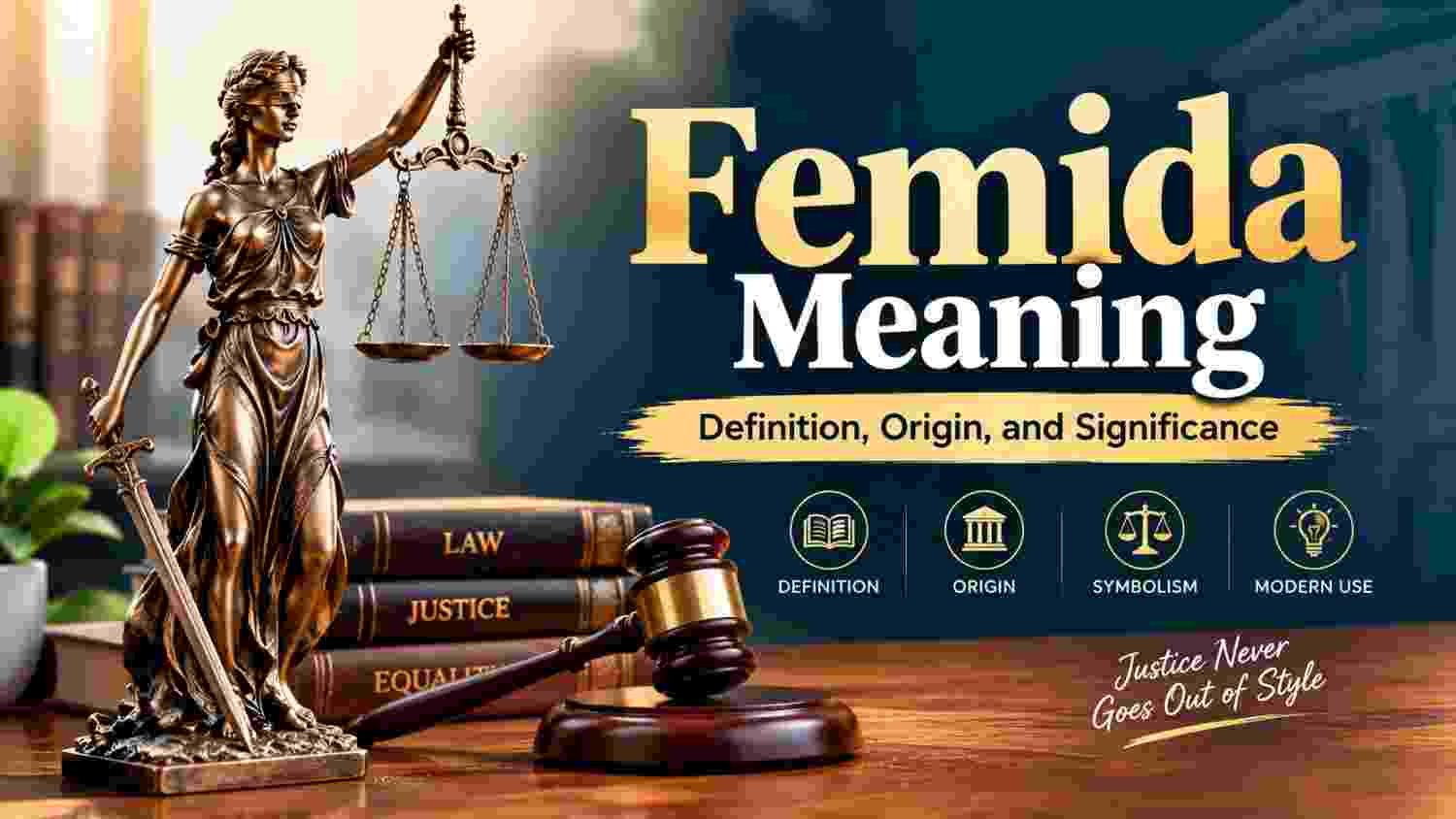
Femida Meaning: The Complete Guide to the Goddess of Justice, Law, and Divine Order
You searched for the femida meaning and found scattered, confusing answers everywhere. Most sources mix up Greek and Roman mythology, leaving you more lost than before. This guide clears every doubt completely. You will learn exactly who Femida is, what she symbolizes, and why her image still stands outside courthouses worldwide.
What Is the Femida Meaning in Greek Mythology?
The femida meaning traces directly back to ancient Greece. Femida is the Slavic and Russian name for Themis, the Titan goddess of divine law, order, and fairness. She belonged to the first generation of Titans, born from Uranus (the sky) and Gaia (the earth).
Her name carries the idea of “that which is put in place” or “divine order.” She did not create human laws. She represented the natural, universal rules that existed before any government or king.
When people ask about the femida meaning, they want to understand this deeper concept. She stands for the belief that justice is not a human invention. Justice exists as a cosmic force that holds the universe together.
The ancient Greeks worshipped her at Delphi, where she served as the second keeper of the Oracle before Apollo took over. This fact alone shows how central she was to Greek spiritual life.
The Origin Story Behind Femida
Femida appeared in the earliest Greek texts, including Hesiod’s Theogony, written around 700 BCE. Hesiod listed her among the most respected Titans. She later became one of Zeus’s wives and bore several important children.
Her daughters included the Horae (goddesses of the seasons and natural order) and the Moirai (the three Fates who controlled human destiny). This family tree tells you something important about the femida meaning. Justice connects directly to time, fate, and the natural rhythm of life.
She advised Zeus on Mount Olympus. Gods and mortals alike sought her counsel before making major decisions. Her word carried weight because she spoke for the universe itself, not for any single ruler.
According to the World History Encyclopedia, Themis held a position of unmatched respect among the Olympian gods because she embodied the moral structure of the cosmos.
Femida Meaning and Her Role as Goddess of Divine Law
The femida meaning goes far beyond courtroom drama. She governed themis — the Greek concept of divine law that existed above human legislation. Kings could pass unfair laws. Femida’s laws could never bend.
She protected oaths, hospitality, and the rights of the vulnerable. When a host mistreated a guest in ancient Greece, people believed Femida herself took notice. When a ruler broke a sacred promise, her justice followed.
This distinction matters today. Human laws change with elections and political pressure. The femida meaning reminds us that true justice operates on a higher level. It does not shift based on popularity or power.
Her role also included organizing the assemblies of gods. She called meetings to order and ensured every voice received a fair hearing. This makes her the original symbol of due process.
The Scales, Sword, and Blindfold: Decoding Femida’s Symbols
Every symbol attached to Femida carries a specific message. Understanding these symbols unlocks the full femida meaning for modern readers..
Each symbol reinforces the core femida meaning: fairness must be measured, enforced, and applied without bias.
How Femida Differs From Lady Justice
Many readers confuse Femida with Lady Justice. The confusion makes sense because both figures look nearly identical. However, important differences exist.
Femida (Themis) is the original Greek goddess. She represents divine, natural law — the kind of justice written into the fabric of the universe. Justitia is the Roman adaptation. The Romans borrowed her image and renamed her to fit their legal system.
Justitia focuses more on human legal proceedings and civic order. Femida focuses on cosmic balance and moral truth. The femida meaning leans spiritual and universal. Justitia leans practical and governmental.
The blindfold appeared on Justitia statues first, around the 15th century in Europe. Original Greek depictions of Themis never showed her blindfolded. She had clear eyes because divine justice sees everything perfectly.
| Feature | Femida (Themis) | Justitia (Lady Justice) | Ma’at (Egyptian) |
| Origin | Ancient Greece | Ancient Rome | Ancient Egypt |
| Era | ~700 BCE texts | ~1st century BCE | ~2400 BCE |
| Domain | Divine & natural law | Civic & human law | Cosmic truth & balance |
| Blindfold | No (original depictions) | Yes (added ~15th century) | No |
| Key Symbol | Scales + laurel wreath | Scales + sword + blindfold | Ostrich feather |
| Parent Deity | Uranus & Gaia | Adapted from Themis | Ra (Sun God) |
| Cultural Role | Advisor to Zeus | Symbol of Roman courts | Judge of the afterlife |
This table shows how the femida meaning connects to a global tradition of justice goddesses spanning thousands of years.
Femida Meaning Across Different Cultures and Traditions
The femida meaning resonates far beyond Greece. Almost every ancient civilization produced a similar figure.
In Egypt, Ma’at weighed the hearts of the dead against a feather of truth. In Norse mythology, Forseti settled disputes among gods and humans. In Hindu tradition, Yama judged souls based on their earthly actions.
These parallels prove that the concept behind Femida is universal. Every culture recognized that societies need a higher standard of fairness to survive. The femida meaning taps into this shared human instinct.
Slavic and Eastern European cultures adopted the name “Femida” directly from Greek sources. In Russia, Ukraine, and Poland, the word “Femida” is still the standard term for justice in legal and literary contexts.
Britannica confirms that Themis influenced legal symbolism across European and Middle Eastern traditions for over two millennia.
Why Courts Around the World Still Display Femida Statues
Walk past any major courthouse in Europe, the Americas, or Asia. You will likely see a statue of a blindfolded woman holding scales. That image descends directly from the femida meaning.
Courts display her image to communicate a clear message to everyone who enters. The building operates under principles of fairness, balance, and impartiality. The statue serves as a constant reminder to judges, lawyers, and defendants alike.
The United States Supreme Court building features multiple representations of Themis and Justitia. The Old Bailey in London displays a prominent Lady Justice statue on its dome. The Federal Court of Justice in Germany keeps a large Femida figure in its main hall.
These statues are not decorative. They function as visual oaths. Every person who works inside those walls pledges to uphold the standards Femida represents.
Femida in Modern Legal Systems and Symbolism
The femida meaning shapes modern legal language more than most people realize. Terms like “due process,” “equal protection,” and “impartial jury” all echo her original principles.
When a judge recites the oath of office, they promise to administer justice without fear or favor. That promise mirrors Femida’s ancient role as the impartial advisor of Zeus. The blindfold concept appears in modern judicial ethics codes worldwide.
Law schools in Eastern Europe still refer to justice as “Femida” in lectures and textbooks. Legal journals in Russia and Ukraine frequently use the phrase “the scales of Femida” when discussing landmark court decisions.
The femida meaning also appears in modern branding. Law firms, legal tech startups, and human rights organizations use her image in logos to signal trust and fairness.
Femida Meaning in Art, Literature, and Popular Culture
Artists have depicted Femida for over 2,500 years. Ancient Greek pottery shows her seated beside Zeus, holding a laurel branch. Renaissance painters placed her in elaborate courtroom scenes surrounded by angels and scholars.
In literature, Dostoevsky referenced Femida in The Brothers Karamazov when exploring questions of moral guilt and divine punishment. Shakespeare’s plays frequently invoke the “scales of justice,” an image borrowed directly from her iconography.
Modern pop culture keeps her alive too. Television legal dramas use her statue as a backdrop. Video games like Hades and God of War feature Themis as a character or reference her legacy in dialogue.
The femida meaning continues to evolve as new generations reinterpret her symbols for contemporary audiences.
The Connection Between Femida and Modern Human Rights
The femida meaning aligns closely with the principles outlined in the Universal Declaration of Human Rights (1948). Article 7 states that all people are equal before the law. Article 10 guarantees the right to a fair and public hearing.
These modern legal protections echo the same values Femida championed in ancient Greece. She believed every person — mortal or divine — deserved a fair hearing before an impartial authority.
Human rights organizations frequently invoke her imagery during campaigns for judicial reform. When activists demand an end to corrupt courts or biased sentencing, they call for a return to the femida meaning: justice that sees no face, only truth.
Her legacy proves that the fight for fairness is not a modern invention. It is a human constant that stretches back to the earliest civilizations.
How to Understand Femida’s Influence on Everyday Justice
You encounter the femida meaning more often than you think. Every time a teacher grades students by the same rubric, that reflects her principle of equal measurement. Every time a referee applies the same rules to both teams, that mirrors her balanced scales.
In your daily life, fairness operates on the same foundation Femida established. People want to be heard. People want decisions based on evidence, not favoritism. People want consequences that match actions.
Understanding the femida meaning helps you recognize these patterns. It gives you a framework for evaluating whether the systems around you — at work, in school, in government — truly operate with justice.
When you see her statue outside a courthouse, you now know the full story behind it. You know she represents something older and deeper than any single legal code.
Final Word: Carry the Femida Meaning Forward
The femida meaning is not a dusty relic trapped in mythology textbooks. It is a living standard that shapes how courts operate, how laws are written, and how ordinary people demand fairness every single day.
Now that you understand her origin, her symbols, and her global influence, you carry a piece of that ancient wisdom with you. Share this knowledge. Challenge unfair systems. Hold your own decisions to the same balanced standard she set thousands of years ago.
Justice does not wait for permission. It starts with people who understand what fairness truly looks like.