Misconception Meaning: Clear Definition & How to Overcome
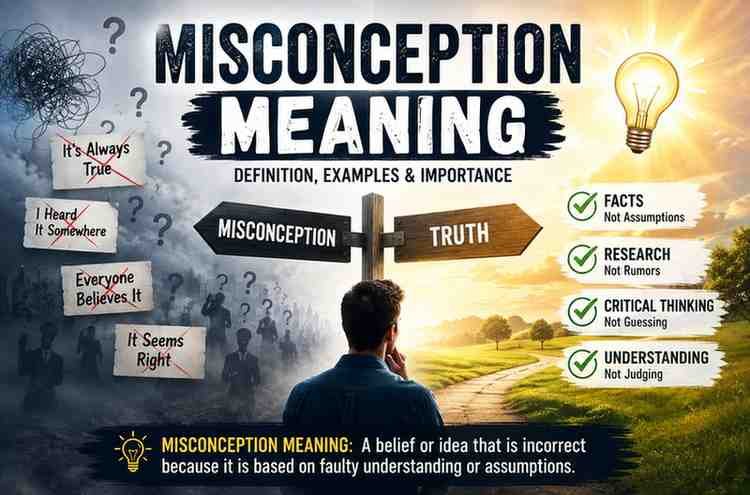
You act on a belief, only to discover it’s completely wrong. That nagging feeling of embarrassment? It’s the result of a misconception. A misconception meaning a false or inaccurate view that distorts your understanding of reality. Without correction, these mental errors quietly sabotage decisions. In this guide, you’ll learn exactly what a misconception is, why it forms, and how to dismantle it for clearer thinking.
Quick Overview: Misconception Meaning at a Glance
| Aspect | What It Involves |
| Core Definition | A false, inaccurate, or incomplete understanding of a fact, concept, or situation. |
| Origin | Faulty reasoning, incomplete information, cultural myths, or cognitive shortcuts. |
| Common Synonyms | Fallacy, myth, false belief, error, misunderstanding, mistaken notion. |
| How It Differs from a Simple Mistake | A mistake is a one-time action; a misconception is a lasting pattern of wrong thinking. |
| Real-World Impact | Skewed decisions, learning barriers, communication breakdowns, and misplaced trust. |
| Correction Approach | Targeted relearning, evidence exposure, critical questioning, and self-reflection. |
What Is a Misconception? The Complete Misconception Meaning
A misconception is not just a random error. The American Psychological Association defines it as an inaccurate or misleading understanding of a concept or phenomenon (APA Dictionary of Psychology). More than a fleeting slip, this misalignment between what you believe and what is actually true can persist for years.
Whenever you hear the term “misconception meaning,” think of a firmly held view that contradicts established facts. For instance, many people believe lightning never strikes the same place twice — a classic misconception that weather data disproves. Unpacking the real misconception meaning lets you separate lore from reality, an essential skill for sound reasoning.
Misconception vs. Misunderstanding: Key Differences
People often use the two words interchangeably, yet they carry different weight. A misunderstanding is a temporary failure to grasp something correctly, usually cleared up with a quick explanation. The full misconception meaning points to a deeper, more stubborn false belief that resists quick fixes.
You might misunderstand a co-worker’s tone in a single email, but a misconception about their overall character colors every future interaction. Recognizing this gap helps you choose the right strategy: quick clarification for a misunderstanding, and structured unlearning for a misconception.
How Misconceptions Form in the Mind
Your brain loves shortcuts. Cognitive psychologist Daniel Kahneman explains that mental heuristics, while efficient, can lead to systematic errors in thinking (Kahneman, Thinking, Fast and Slow, 2011). These shortcuts create fertile ground for the misconception meaning to take root. Add incomplete education, oversimplified analogies, or emotionally charged stories, and a false belief can harden before you ever question it. A child who learns that the Earth is round may later envision it as a perfectly smooth ball, ignoring mountains and ocean trenches. That innocent simplification evolves into a misconception that can survive into adulthood.
The Psychology Behind Persistent False Beliefs
Once a misconception settles, it becomes self-reinforcing. Confirmation bias pushes you to notice only the evidence that supports your existing view. The backfire effect can make you cling to the misconception even when someone presents solid counter-evidence.
This explains why the misconception meaning is not just about ignorance; it involves identity and ego. You’ve likely defended a wrong fact because letting go felt like admitting you were gullible. Understanding the emotional glue helps you approach corrections with empathy — both for yourself and for others.
Common Misconceptions in Everyday Life
You encounter dozens of misconceptions daily without realizing it. Consider these widespread examples:
- Humans use only 10% of their brains. Brain scans show activity across all regions, even during rest.
- Bats are blind. They see perfectly well and use echolocation to hunt in darkness.
- Goldfish have a three-second memory. Research proves they can remember for months and learn tasks.
- Cracking knuckles causes arthritis. No scientific link exists; the sound comes from gas bubbles bursting in joint fluid.
Each of these illustrates the misconception meaning: a belief held with certainty that fails under scrutiny.
Misconceptions in Science and Why They Stick
Science classrooms are battlegrounds for persistent false beliefs. Stella Vosniadou’s research on conceptual change shows that students often build “synthetic models” — blending correct instruction with pre-existing false notions (Vosniadou, 1994). This makes the misconception meaning especially tricky in education. For example, many learners believe that heavy objects fall faster than light ones, ignoring the principle of gravitational acceleration in a vacuum. Such misconceptions survive because they align with intuitive, everyday experiences rather than with abstract scientific laws. Active experimentation and direct observation remain the most effective tools to unravel them.
Historical Misconceptions That Shaped Society
False beliefs have redirected the course of history. For centuries, people held the geocentric model — the misconception that Earth sits at the center of the universe — as absolute truth. This single misconception delayed astronomical progress and punished those who questioned it.
Another powerful case: the belief that diseases spread through “bad air” (miasma) stalled advances in hygiene until germ theory gained acceptance. Grasping the historical misconception meaning reveals how collective false beliefs can stall innovation, influence politics, and even endanger lives. It also shows that questioning inherited “truths” is a civic responsibility.
Misconceptions in Education and Learning
Teachers regularly confront the misconception meaning when students arrive with preformed ideas that clash with the curriculum. In mathematics, the idea that multiplying always makes a number larger persists until learners encounter fractions. In grammar, many students think a sentence cannot end with a preposition, a rule based on Latin conventions rather than English usage. Addressing these false beliefs requires diagnostic questioning — asking “What do you think happens when…” before delivering the correct concept. The goal is to create a “cognitive conflict” that makes the misconception visible and replaceable.
How to Identify and Correct Your Own Misconceptions
Self-correction begins with a willingness to be wrong. Ask yourself three questions whenever you feel certain about a fact:
- Where did I learn this? Trace the source. A casual remark, a movie, or a poorly remembered lesson can be the seed.
- What evidence supports it? Distinguish between personal experience and verified data.
- Would an expert agree? Check against trusted authorities, not just popular opinion.
This reflective practice aligns with the true misconception meaning — not as a failure but as a fixable gap in knowledge. Replace the false belief by deliberately studying the accurate concept and explaining it aloud to someone else.
The Impact of Misconceptions on Decision-Making
When your mental model of reality is flawed, your decisions suffer. A business owner who holds the misconception that social media marketing is free and effortless will under-invest and lose revenue. A patient who believes antibiotics cure all infections — including viruses — may pressure a doctor for unnecessary prescriptions, fueling antibiotic resistance. The misconception meaning extends into health, finance, relationships, and public policy. Each poor choice built on a false belief compounds over time, making early detection a form of future-proofing your life.
Cultural Misconceptions and Their Consequences
Cultures trade in shared narratives, some of them inaccurate. National stereotypes often persist as group-level misconceptions: the idea that certain nationalities are “naturally” lazy, aggressive, or brilliant. These false beliefs fuel prejudice and close doors before individuals even get a chance.
The misconception meaning, when applied to entire populations, becomes dangerous folklore that shapes hiring, legal judgments, and social trust. Breaking cultural misconceptions demands direct contact with diverse people and stories — not secondhand reports — so your brain rewrites the faulty template with real human data.
Tools and Strategies to Break Free from False Beliefs
Equipping yourself with the right mental tools turns the misconception meaning from a barrier into a challenge. Try these methods:
- Falsification mindset: Instead of asking “What supports my belief?” ask “What would prove it wrong?” If you can’t conceive of disconfirming evidence, the belief is likely unfalsifiable and suspect.
- Pre-mortem thinking: Before a decision, imagine you acted on a misconception and it failed. Work backwards to find the weak assumption.
- Peer debate: Articulate the belief to a critical friend who plays devil’s advocate. The act of explaining often exposes hidden flaws.
- Learning sprints: Dedicate short, focused blocks to read primary sources on the topic, not just summaries.
These strategies transform passive acceptance into active, evidence-grounded thinking.
Frequently Asked Questions About Misconception Meaning
1. What is the simple definition of misconception meaning?
It refers to a false or inaccurate belief that a person holds as true, often resulting from incorrect learning, partial information, or flawed reasoning. The core of the misconception meaning lies in the gap between what is believed and what is factually correct.
2. How is a misconception different from a mistake?
A mistake is a one-time action or slip — like pressing the wrong button. A misconception is a deeply held wrong view that influences ongoing thinking and behavior. Grasping the misconception meaning helps you see it as a pattern, not an isolated incident.
3. Why do misconceptions persist even after learning the truth?
Cognitive biases such as confirmation bias and the tendency to avoid mental discomfort protect existing beliefs. The misconception meaning includes this resistance to change because admitting a long-held view is wrong can feel threatening.
4. Can you completely eliminate all misconceptions?
Probably not. New information always arrives with gaps, and your brain naturally fills them with assumptions. But understanding the misconception meaning allows you to build habits that catch and correct false beliefs quickly, keeping their impact small.
5. How do I identify a personal misconception?
Notice moments of surprise or confusion — they often signal a clash between your expectation and reality. Ask “What did I assume to be true here?” Tracing that assumption back to its source can reveal a misconception meaning that you weren’t aware of.
6. What role do misconceptions play in critical thinking?
They serve as obstacles that critical thinking aims to dismantle. Learning the misconception meaning sharpens your ability to question claims, evaluate evidence, and update your views — turning you into a more disciplined thinker.