Oblivion Meaning: Definition, Origins, and Usage Guide
You’ve heard someone say “fading into oblivion,” but what exactly does that mean? The word gets tossed around, yet its full depth remains fuzzy. Misusing it can weaken your writing or muddy a serious discussion. This guide breaks down the complete oblivion meaning—from its Latin roots to its weight in philosophy and pop culture—so you can use it with absolute confidence.
What Is the Basic Oblivion Meaning?
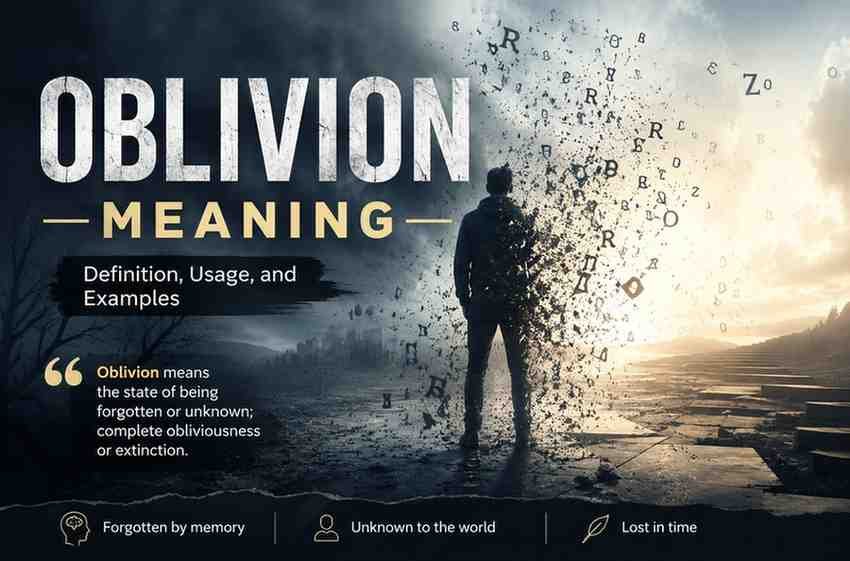
The most direct oblivion meaning points to a state of being completely forgotten, destroyed, or erased from memory. Dictionaries define it as the condition of being unaware or unconscious, or the total extinction of something that once existed. People use it to describe physical destruction, mental blankness, and historical erasure. When a once-famous singer slides into obscurity, you can say they vanished into oblivion. Grasping this core definition unlocks every nuance the word carries.
The Etymology and Origin of ‘Oblivion’
The oblivion meaning traces back to the Latin verb oblivisci, which translates to “to forget.” This root also gave English the word oblivious. In Middle English, oblivion entered the language through Old French, carrying the sense of “forgetfulness” and “the state of being forgotten.” Early writers used it to frame both the merciful forgetting of pain and the terrifying loss of self. Understanding this origin helps you appreciate why the word teeters between comfort and dread depending on context.
Oblivion Meaning in Philosophy: The Fear of Nonexistence
Philosophers often examine the oblivion meaning through the lens of mortality. Epicurus famously argued that death equals nonexistence—a complete absence of sensation. If you don’t exist, you experience nothing to fear. Yet, many people still tremble at the thought of eternal oblivion. Thomas Nagel later challenged the Epicurean view by suggesting that the deprivation of life’s goods makes death an evil, even if oblivion itself involves no suffering. The Stanford Encyclopedia of Philosophy explores these debates, framing oblivion as the ultimate unknown that shapes human values.¹
Psychological Perspectives: Oblivion and Memory Loss
When psychologists discuss oblivion meaning, they often connect it to severe memory loss or dissociative states. A person in a fugue state might wander in a fog of oblivion, unaware of their identity. Traumatic brain injuries can also plunge someone into a cognitive oblivion where personal history vanishes. These clinical uses mirror the literary concept: oblivion steals the narrative thread of a life. Therapists work to pull patients back from that oblivion by restoring the continuity of memory.
Oblivion in Literature and Poetry: Symbolism and Metaphor
Writers have long weaponized oblivion meaning to evoke loss, peace, or the passage of time. Shakespeare’s plays treat oblivion as both a threat to legacy and a cure for heartbreak. In John Keats’s “Ode to a Nightingale,” the speaker longs to “fade far away, dissolve, and quite forget”—a poetic dive into sensory oblivion. Modern authors like Milan Kundera use oblivion to explore how societies erase inconvenient history. The word’s emotional charge makes it a favorite for describing the tension between memory and silence.
Oblivion Meaning in Popular Culture: From Movies to Video Games
Popular culture has stamped its own imagery onto the oblivion meaning. The role-playing video game The Elder Scrolls IV: Oblivion turns the term into a hellish dimension of chaos and fire. The 2013 film Oblivion, starring Tom Cruise, frames it as a post-apocalyptic blank slate stripped of memory. Both works exploit the primal fear of losing everything you know. When a brand or franchise uses “oblivion” in its title, it taps into that deep-seated horror of nonexistence and the struggle to reclaim meaning.
The Difference Between Oblivion, Oblivious, and Obliterate
Many people confuse oblivion with similar-sounding words. Oblivious describes a person who is unaware of their surroundings—a mental fog, not a total void. Obliterate means to destroy something completely, leaving no trace. Oblivion meaning refers to the state that results after obliteration or the condition of being unaware. Think of it this way: a wrecking ball obliterates a building; the building falls into oblivion; a bystander staring at their phone remains oblivious to the whole event.
Synonyms and Antonyms for Oblivion: A Quick Reference
Knowing the right synonyms sharpens your understanding of oblivion meaning.
- Common synonyms: forgetfulness, nonexistence, void, annihilation, extinction, obscurity, unawareness.
- Common antonyms: awareness, consciousness, remembrance, fame, immortality, recollection.
When you call a memory a “void,” you lean on a similar feeling, but oblivion adds a heavier sense of finality. Picking the exact synonym depends on whether you emphasize forgetting, destruction, or blankness.
How to Use ‘Oblivion’ Correctly in a Sentence
Applying the oblivion meaning properly boosts your writing.
- “The ancient city crumbled into oblivion after the earthquake.” (total destruction and forgetting)
- “Alcohol offered temporary oblivion from his grief.” (a state of unawareness or numbness)
- “Her groundbreaking work saved her from historical oblivion.” (being forgotten)
Avoid using it as a synonym for mere distraction. Saying “I was in oblivion during the boring lecture” overstates the case unless you genuinely lost all awareness.
Common Misconceptions About Oblivion
A few myths cloud the oblivion meaning. Some believe it always implies violence, yet a quiet, peaceful erasure fits just as well. Others treat it as interchangeable with death, but oblivion can describe living states like deep unconsciousness or cultural forgetting. Another mistake equates oblivion with ignorance—ignorance is a lack of knowledge, while oblivion is a lack of existence or awareness itself. Clearing up these misconceptions makes you a more precise communicator.
The Spiritual and Religious Views on Oblivion
Spiritual traditions assign varied oblivion meaning. Buddhism’s concept of Nirvana can resemble a blissful oblivion of the ego—an extinguishing of desire and individual selfhood. In contrast, many Western religions reject the idea that souls dissolve into oblivion after death, insisting on eternal consciousness. Some mystics pursue meditative states that mimic temporary oblivion as a path to divine union. These perspectives show how the same word can represent ultimate peace or absolute terror, depending on your worldview.
What Is Eternal Oblivion and Its Implications?
Eternal oblivion describes the permanent cessation of consciousness after death, with no memory, sensation, or selfhood remaining. This interpretation of oblivion meaning sits at the heart of materialist philosophies. The physicist Sean Carroll and philosopher Owen Flanagan have discussed how a universe without an afterlife renders every human project precious—precisely because oblivion is final.² Facing this possibility can provoke anxiety or, paradoxically, a liberating urgency to live fully now.
A Detailed Table of Oblivion Meaning Across Contexts
| Context | Definition/Nuance | Example Sentence | Related Entity/Concept |
| General English | State of being forgotten or destroyed | “The abandoned factory rotted into oblivion.” | Dictionary entry (Merriam-Webster) |
| Philosophy | Nonexistence after death; lack of experience | “Epicurus taught that eternal oblivion is nothing to fear.” | Epicurus, Nagel, Death |
| Psychology | Profound memory loss or dissociative blankness | “The accident left him in a mental oblivion.” | Amnesia, fugue state |
| Literature | Metaphor for loss, peace, or erasure | “Keats yearned for the soft oblivion of the nightingale’s song.” | Keats, Shakespeare, Kundera |
| Pop Culture | Apocalyptic dimension or blank future | “In The Elder Scrolls IV, Oblivion is a realm of Daedric chaos.” | The Elder Scrolls IV: Oblivion, film Oblivion |
| Spirituality | Extinguishing of self or ego | “Meditation offered a temporary oblivion of the self.” | Nirvana, mysticism |
Frequently Asked Questions
What does oblivion mean in simple terms?
Oblivion simply means the state of being completely forgotten, destroyed, or unaware. You can think of it as a total blank where something or someone once existed.
Is oblivion the same as death?
No. Death is the end of biological life, while the oblivion meaning often refers to the conscious experience—or lack thereof—after death. A person can also experience temporary oblivion through unconsciousness without dying.
Can oblivion be used in a positive way?
Yes. People sometimes seek the oblivion of sleep, meditation, or even temporary distraction to escape pain. In that sense, oblivion offers relief from overwhelming suffering.
What is the etymology of oblivion?
The word comes from the Latin oblivisci, meaning “to forget.” This root reveals why the oblivion meaning always circles back to forgetfulness and erasure.
How do you pronounce oblivion?
Pronounce it as uh-BLIV-ee-uhn, with the stress on the second syllable. The “o” sounds like a short “uh,” and the “i” is a short “i” as in “live.”
What is the difference between oblivion and ignorance?
Ignorance is the absence of knowledge about something. Oblivion is the absence of awareness or existence itself. You can be ignorant of a fact and still fully conscious, but oblivion implies a much deeper void.