7 Powerful Secrets of Ineffable Meaning (Essential Guide)
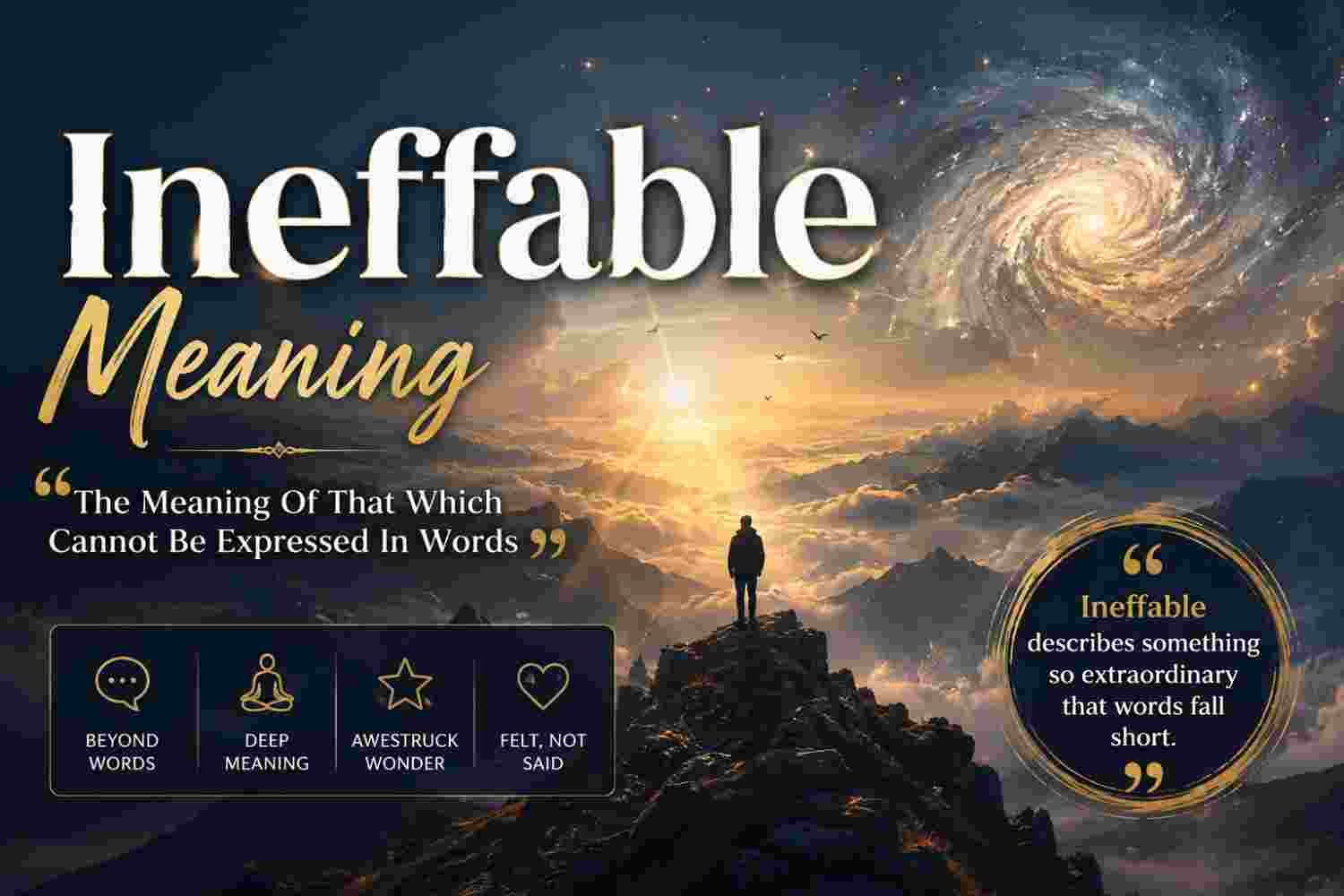
Have you ever stood on a mountaintop, witnessed a birth, or listened to a piece of music that made the hair on your arms stand up, only to open your mouth and realize you sound like a broken robot? You aren’t failing at language; you are experiencing the limits of the dictionary. The ineffable meaning points to that massive gap between what you feel in your bones and what your tongue can actually say.
Most people think they just lack vocabulary. That is a lie. The truth is, some experiences are so complex, so layered, and so deeply personal that they short-circuit the language centers of the brain. By the end of this guide, you will stop trying to force words onto the impossible and start understanding the psychology behind this beautiful, silent struggle.
The Definition: Breaking Down the Ineffable Meaning
Let’s start with the root of the word because that is where the magic hides. The term “ineffable” comes from the Latin ineffabilis. If you strip that down, you get *in-* (meaning “not”) and effabilis (meaning “speakable”).
But that feels too basic, doesn’t it? When we talk about the ineffable meaning, we aren’t just talking about a secret you refuse to tell. We are talking about an experience that is so overwhelming, so intricate, or so sacred that human language collapses under its weight.
The Etymology Trap
People often confuse “ineffable” with “taboo.” They are not the same. Taboo things are forbidden to speak about. Ineffable things are impossible to speak about.
There is a massive difference between choosing not to speak and lacking the ability to speak. The ineffable meaning lies in ability, not permission. It is a limitation of the tools we have, not a rule we are breaking.
The Cliché Problem
Ironically, the word “ineffable” has become a cliché in poetry. Bad poets use it to sound deep. But when used correctly, it describes the highest peaks of human emotion. It is the word we use when we try to explain the nature of God, the feeling of true love, or the terror of staring into the void of space.
The Psychology of the Unspeakable
Why can’t we just describe these things? If we have a word for “sadness” and a word for “joy,” why don’t we have words for the mix of both during a wedding or a funeral?
That is because the human brain processes trauma, awe, and transcendence differently than it processes everyday events.
The Amygdala Hijack
When you experience something truly profound, your brain’s logic centers (the prefrontal cortex) take a back seat. Your emotional centers light up like a Christmas tree. You are in a state of high arousal, but your “naming” functions go offline.
Think of it like a computer. If you are running a massive, high-definition video game, you might not have the processing power left to run a voice chat smoothly. The system starts to lag. Your emotional experience is so “heavy” that the language software crashes.
“Peak Experiences”
Psychologist Abraham Maslow (famous for the hierarchy of needs) coined the term “peak experiences.” He described these as moments of pure, positive euphoria where time seems to stand still.
Maslow noted that these moments are frequently described as “ineffable.” People who have them often say things like, “I can’t put it into words,” or “You just had to be there.” This isn’t a cop-out; it is the brain admitting that the data it received was too rich for standard compression into words.
7 Powerful Secrets to Understand Ineffable Meaning
To truly grasp this concept, you need to look beyond the dictionary. Here are seven deep insights into how the ineffable works in the real world.
1. It Protects the Sacred
In many religious traditions, the name of God is considered ineffable. The logic is simple: if you can name something, you can control it, limit it, or insult it. By keeping the ultimate truths “unspeakable,” they remain perfect and uncorrupted by human language.
2. It Marks True Expertise
A beginner in any field will talk your ear off. A master will often stay quiet. This is because the master understands the nuances that words cannot capture. They know that a “recipe” cannot cook a meal, and a “manual” cannot drive a car. The gap between knowledge and action is often ineffable.
3. It Is the Root of “Awe”
Scientists who study the emotion of “awe” (the feeling you get looking at the Grand Canyon) note that this emotion silences the ego. You feel small. You feel quiet. You are experiencing an ineffable moment because your sense of self—which is required for speech—has temporarily dissolved into the landscape.
4. It Distinguishes Art from Commerce
A commercial jingle is designed to be remembered and repeated. It is effable (speakable). High art, however, aims for the ineffable. When you look at a Rothko painting, you don’t ask, “What is it a picture of?” You ask, “What am I feeling?” The art is working precisely because it bypasses words.
5. It Creates Intimacy
When two people share an ineffable moment—like a terrifying near-miss accident or a hilarious inside joke—they bond. Because they cannot fully explain the experience to outsiders, the shared silence becomes a secret handshake. Language separates; the ineffable unites.
6. It Is a Moving Target
What was ineffable yesterday might be common today. In the 1800s, the idea of “melancholy” or “nostalgia” was considered a deep, complex, almost unspeakable medical condition. Today, we use those words casually. As our vocabulary evolves, we capture some concepts, but new depths of feeling always emerge.
7. It Drives Poetry
Poetry is essentially a tool designed to fail better. Poets know they cannot describe a sunset. So, they use metaphor to circle around the ineffable meaning, hoping to trigger the feeling in your mind rather than explaining it logically.
How Ineffability Shows Up in Daily Life
You don’t have to be a monk or a philosopher to hit the limits of language. You hit it every week. Here are the most common triggers.
The “Vibe” of a Room
You walk into a party and immediately feel uncomfortable. You can’t point to a specific reason. The lighting is fine, the people are smiling, but the gestalt—the overall vibe—is off. That “vibe” is ineffable. It is the sum of a thousand micro-signals that your brain processed faster than your consciousness could translate into words.
The Complexity of Grief
If someone loses a loved one, we often say, “I’m sorry for your loss.” The bereaved usually nod and say “thank you.” But if you ask them how they really feel, they often can’t tell you. Is it anger? Relief? Regret? Sadness?
It is usually all of these mixed together in a soup that has no name. Grief is a prime example of the ineffable meaning because it is not one emotion; it is a system failure of emotions.
The Sensation of Déjà Vu
You experience a moment and are absolutely certain you have lived it before. You know the feeling perfectly. It is distinct, eerie, and unmistakable. Yet, when you try to explain why it feels different from normal memory, you stutter. The feeling of familiarity without context is notoriously difficult to capture in sentences.
When You Should Stop Trying to Explain
In our modern culture, there is pressure to “communicate” everything. We think that if we can’t articulate a feeling, we haven’t processed it. This is a toxic myth.
Trying to force the ineffable into a spreadsheet of words can actually ruin the experience.
The “Dissection” Effect
There is a famous saying: “We murder to dissect.” If you spend your entire honeymoon trying to journal every specific emotion you have, you stop having the honeymoon. You become an observer of your own life, trying to translate the sunset into adjectives instead of just watching it.
The Value of Silence
Sometimes, the correct response to the ineffable is silence. It is a nod of acknowledgment. It is a deep sigh. It is a tear.
By accepting the ineffable meaning, you allow yourself to be a human being rather than a recording device. You can sit with the feeling, let it wash over you, and let it change your body without needing to write a review about it.
Table: Effable vs. Ineffable Experiences
To visualize how this works, look at the difference between these categories of life.
| Aspect of Life | Nature of Experience | Relationship to Language |
|---|---|---|
| Grocery Shopping | Transactional & Logical | Effable (Easy to describe: I bought milk). |
| Coding/Mathematics | Rule-based & Precise | Effable (Can be written down exactly). |
| Tasting Wine | Sensory & Subjective | Semi-Ineffable (You need metaphors to describe “oaky”). |
| Deep Meditation | Ego-dissolving & Timeless | Ineffable (Words cannot capture the state of non-being). |
| Peak Experiences | Overwhelming & Transcendent | Ineffable (Language breaks down entirely). |
This table shows a clear spectrum. The further you move away from logic and toward raw sensation, the less useful language becomes.
How to Use “Ineffable” in Your Writing
If you are a writer, you should use this word sparingly. It is a spice, not the main course.
Show, Don’t Tell
If you write, “The view was ineffable,” the reader yawns. You have told them nothing. They don’t feel it.
Instead, show the failure of language. Write: “She opened her mouth to speak, but no sound came out. She looked at her husband, pointing at the valley below, tears streaming down her face. He nodded. He knew. He didn’t need the words.”
In that passage, you showed the ineffable meaning without using the word. You showed the character’s body reacting to something too big for words.
The Power of Juxtaposition
Place the ineffable next to the mundane. Write about a soldier returning from war. He sits in a diner, and a waitress asks, “How was it over there?” The soldier looks down at his coffee. The pause is deafening. The war is ineffable. The coffee is effable. The contrast highlights the weight of what cannot be said.
Frequently Asked Questions (FAQ)
1. What is the exact ineffable meaning?
The exact ineffable meaning refers to something that is impossible to express in words. It stems from the Latin word ineffabilis, which means “not speakable.” It describes experiences, feelings, or concepts that are too great, too extreme, or too sacred to be described using ordinary language.
2. Is “ineffable” always a religious word?
No, it is not always religious, though it has deep roots in theology. While people often use it to describe the nature of God or spiritual enlightenment, you can also use it for secular experiences. The feeling of falling in love, the overwhelming beauty of nature, or the trauma of a severe accident can all be ineffable.
3. What is the difference between “ineffable” and “unspoken”?
“Unspoken” means something is left unsaid by choice or by social rule; the words exist, but you don’t say them. “Ineffable” means the words do not exist or are insufficient. You cannot say them because language lacks the capacity to capture the reality of the experience.
4. Can a person be ineffable?
Yes, in a poetic sense. We often say a person has an “ineffable quality.” This means they have a charisma, charm, or presence (a “je ne sais quoi”) that you can recognize immediately but cannot break down into specific traits. Their attractiveness or power is a mystery to the mind but obvious to the senses.
5. How do poets express the ineffable if words are useless?
Poets use a technique called “negative capability” or “indirection.” They do not try to hit the target head-on. Instead, they use metaphors, rhythm, and imagery to create a feeling in the reader’s mind that mirrors the original experience. They use words to build a box around the emptiness, letting you feel the shape of the silence.
6. Why do I cry during beautiful music? Is that ineffable?
Yes. Music bypasses the language centers of the brain entirely. It goes straight to the amygdala and the limbic system (the emotional center). When the music builds to a crescendo, it triggers a release of dopamine. You feel overwhelmed by a pattern of sound that you cannot translate into logic. The tears are your body’s way of “speaking” when your mouth cannot.
7. Is “ineffable meaning” the same as “nonsense”?
No. Nonsense lacks logic or sense and is usually disregarded. The ineffable usually makes perfect sense to the person feeling it; it is often described as “more real than real.” The problem is not that the experience is illogical, but that it contains too much logic, data, and emotion for the brain to compress into a sentence.
The Final Verdict on the Unspeakable
Stop beating yourself up for not being able to explain the most important moments of your life. The next time you feel that lump in your throat, or that shiver down your spine, don’t rush to Instagram to caption it. Don’t scramble for a filter to define it.
The ineffable meaning is a reminder that you are more than just a walking dictionary. You are a vessel for experiences that logic cannot touch. Embrace the silence. Let the mystery exist. Sometimes, the most powerful things in life are the ones we can only point to, never speak.