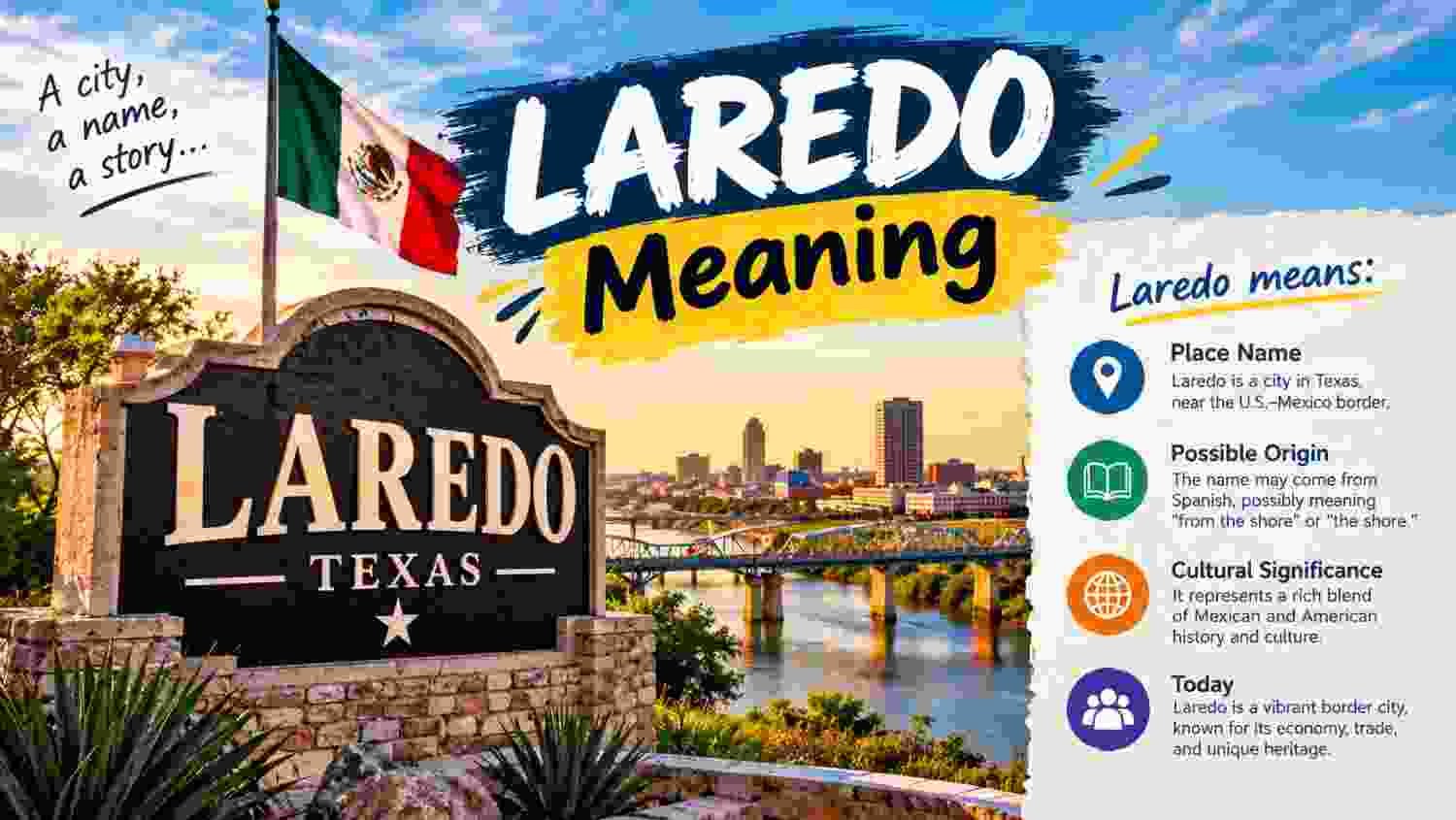
Laredo Meaning: The History, Origin, and Cultural Story Behind the Name
Picture a name crossing borders, oceans, and centuries before appearing on a city sign in Texas, a map of northern Spain, or a modern baby-name list. That journey helps explain the laredo meaning, a phrase people increasingly search when they want to understand the name’s history, pronunciation, and cultural identity.
The name feels distinctly Spanish, yet its story is more complicated than a simple dictionary translation. “Laredo” can refer to a historic coastal town in Cantabria, a major Texas border city, a family name, a place-inspired given name, or a word chosen for its warm Latin American sound. Its appeal comes from that blend of geography, heritage, and strong visual identity.
Quick facts about Laredo
Unlike a celebrity profile, this subject does not have social-media statistics, a career peak, or a personal net worth. Because laredo meaning concerns a place name and word origin, the most useful quick-reference details focus on language, geography, and historical usage.
| Category | Key information |
|---|---|
| Word type | Proper noun and place name |
| Most familiar modern references | Laredo, Spain, and Laredo, Texas |
| Common language association | Spanish |
| Pronunciation | Spanish: lah-REH-doh; English: luh-RAY-doh or luh-REH-doh |
| Main popularity driver | The Texas border city, Spanish heritage, travel, and regional identity |
| Personal-name use | Occasional surname or place-inspired given name |
| Exact English translation | No universally accepted one-word translation |
| Main research question | Whether the name comes from an older Iberian place-name tradition |
What is the meaning of Laredo?
The simplest answer is that Laredo is primarily a place name, rather than an everyday Spanish vocabulary word with one fixed English definition. Someone asking about the laredo meaning may expect a direct translation such as “beautiful land” or “place by the sea,” but those popular explanations are not universally established.
Historical place names often survive long after the original language, pronunciation, or local meaning has changed. Laredo appears in an old Iberian setting, and researchers have proposed different explanations for its roots. Some connect it with the historic town of Laredo in Cantabria, while others discuss possible Latin, pre-Roman, or Basque-related influences.
That uncertainty matters. A responsible explanation should separate documented history from attractive but unproven interpretations. The name has a clear geographic identity, but its earliest linguistic source remains debated.
In everyday use, the name can suggest several ideas:
- A Spanish or Hispanic cultural connection
- A coastal or frontier setting
- Heritage linked to northern Spain
- The Texas–Mexico border region
- Travel, migration, trade, and bilingual communities
- A strong, place-based personal identity
So, when people discuss the laredo meaning, they are often asking about more than vocabulary. They may be asking what the name represents.
The Spanish connection: Laredo in Cantabria
The oldest widely recognized reference is Laredo, a historic town on Spain’s northern coast in Cantabria. Its position beside the Bay of Biscay shaped its development, economy, and public image.
Cantabria has a distinctive cultural history. It sits in northern Spain, where coastal communities, mountain landscapes, old kingdoms, maritime trade, and regional languages have influenced local identity. Laredo’s name belongs to that wider historical landscape.
The town became associated with fishing, shipping, commerce, religious celebrations, and connections across the northern coast. Its beaches and old quarter later helped make it a popular destination for visitors seeking a quieter alternative to Spain’s busiest resort cities.
The Spanish town is important when studying the laredo meaning because place names often travel with explorers, settlers, religious figures, military officials, and colonial administrators. A name first associated with one European location can later become permanently attached to a new settlement thousands of miles away.
Is Laredo a Spanish word?
Laredo is used in Spanish, but that does not mean it functions like a regular Spanish noun or adjective. You would not normally translate it in the same way you translate words such as “river,” “mountain,” or “house.”
It is better understood as a Spanish place name with an older and uncertain etymology. The name is recognized by Spanish speakers, but its original meaning may not be transparent to modern speakers.
This is common around the world. Names such as London, Madrid, Paris, and Dublin also carry long histories that cannot always be explained through the vocabulary of the language spoken there today.
The story of Laredo, Texas
The most famous modern use of the name in the United States is Laredo, Texas. The city sits on the northern bank of the Rio Grande, directly across from Nuevo Laredo in the Mexican state of Tamaulipas.
The settlement was established during the Spanish colonial period in the eighteenth century. Its name reflected the Spanish tradition of naming new communities after familiar places, religious references, officials, or locations connected to earlier history.
Over time, Laredo developed into a major border community. Its location made it important for ranching, transportation, commerce, customs activity, and cross-border family life. The city’s identity cannot be separated from its relationship with Mexico.
This is why the laredo meaning often feels different in the United States than it does in Spain. In Cantabria, the name may bring to mind beaches, maritime history, and northern Spanish culture. In Texas, it evokes the Rio Grande, bilingual life, international trade, Mexican American heritage, and a busy border economy.
Why Laredo, Texas, matters culturally
Laredo is not simply a city named after another city. It has developed its own traditions, food culture, festivals, music, architecture, and civic identity.
The city is known for a deeply connected Mexican American and Hispanic community. Spanish and English exist side by side in daily life, while family histories often cross the border. That blend gives the name an emotional meaning for residents who see Laredo as home rather than just a location on a map.
The annual Washington’s Birthday Celebration is one example of the city’s public identity. Despite its name, the event has grown into a major cultural celebration that includes parades, live entertainment, food, costumes, and community gatherings.
For many people, the laredo meaning therefore includes belonging. It can represent a place where national borders do not erase family connections, language, or shared traditions.
A step-by-step timeline of the name
Understanding the name becomes easier when viewed as a historical sequence.
Step 1: An older Iberian place name emerges
The earliest stage is connected to Laredo in northern Spain. The precise linguistic origin is not settled, and historians may interpret old records differently.
Step 2: The name becomes tied to a Spanish coastal town
As the community develops, Laredo becomes a recognized local place name. Its association with Cantabria gives it a firm geographic identity.
Step 3: Spanish expansion carries the name overseas
During the colonial era, Spanish naming patterns spread across the Americas. Existing names were sometimes reused to honor familiar locations or maintain links with Spain.
Step 4: A new Laredo forms along the Rio Grande
The Texas settlement grows in a region shaped by Indigenous history, Spanish colonial influence, Mexican rule, and later American statehood. The name gains a new chapter in North American history.
Step 5: Laredo becomes a binational reference
Because Laredo, Texas, and Nuevo Laredo, Mexico, face each other across the Rio Grande, the name becomes associated with cross-border movement and shared regional culture.
Step 6: The name enters popular culture
Modern references appear in travel writing, music, sports, local branding, business names, family stories, and online searches. This helps explain the renewed interest in laredo meaning.
Pronunciation: How do you say Laredo?
Pronunciation varies by language and region.
In Spanish, Laredo is commonly pronounced close to lah-REH-doh, with emphasis on the middle syllable. The Spanish “r” is light compared with the strongly curled English “r.”
In American English, people often say luh-RAY-doh, especially when referring to Laredo, Texas. Others use a pronunciation closer to luh-REH-doh, reflecting Spanish influence.
Neither variation automatically signals disrespect or correctness. Pronunciation often reflects a speaker’s language background, family history, or local custom. In formal settings, using the pronunciation preferred by residents is a considerate choice.
What does Laredo symbolize?
The name carries different associations depending on context. Here are the most common symbolic meanings connected with it.
Heritage
Because of its Spanish roots and strong presence in Texas and Mexico, Laredo can symbolize Hispanic heritage and family history.
Movement
The city’s border location gives the name a sense of travel, migration, commerce, and cultural exchange.
Resilience
Border communities frequently manage complex political, economic, and social pressures. Laredo’s identity is often connected with endurance and adaptability.
Connection
The name links Spain, the United States, and Mexico. It also connects communities separated by geography but joined through language and history.
Place-based pride
Residents may use Laredo as a statement of home. The word can carry memories of neighborhoods, festivals, food, relatives, and local traditions.
Laredo as a surname or first name
Laredo is not among the most common first names in English-speaking countries, but it can appear as a surname or a place-inspired personal name.
As a surname, it may reflect family ancestry, regional origin, or a historical connection to one of the towns bearing the name. As a first name, it may appeal to parents who want something distinctive, geographic, and culturally connected.
Parents considering the name should think about pronunciation and context. In the United States, some people may say “luh-RAY-doh,” while Spanish-speaking relatives may prefer “lah-REH-doh.” That difference is manageable, but it is worth anticipating.
The name also has a strong location association. People may immediately think of Texas, Spain, or the Mexico border. That can be an advantage for families who value meaningful place names.
Laredo meaning compared with similar place names
A comparison table helps show why this name is unusual. Unlike common vocabulary words, these names often carry historical associations rather than direct translations.
| Name | Main association | Direct translation? | Cultural impression |
|---|---|---|---|
| Laredo | Spain, Texas, Mexico border | No confirmed single translation | Hispanic, coastal, frontier, connected |
| Valencia | Spanish cities and region | Historically complex | Mediterranean and urban |
| Santa Fe | Spanish religious phrase | Yes: “Holy Faith” | Southwestern and spiritual |
| Monterey | California and Spanish colonial history | Historical name origin | Coastal and Californian |
| El Paso | Texas border city | Yes: “The pass” | Southwestern and geographic |
| Granada | Spain and Latin American references | Origin debated | Historic and artistic |
The comparison shows why the laredo meaning cannot be reduced to a single English word. Its significance depends on the place, language, and personal story attached to it.
What experts and local communities emphasize
Historians generally approach old place names with caution. They examine archival spellings, colonial documents, regional language patterns, maps, and historical pronunciation rather than relying on modern word associations alone.
Local communities often emphasize lived experience. A resident of Laredo, Texas, may focus on family, food, festivals, border identity, or bilingual life. Someone from Laredo in Cantabria may highlight beaches, Spanish history, regional traditions, and the northern coast.
Both views are valid because names gain meaning through use. A name can have an uncertain ancient origin while holding a very clear modern emotional value.
Online discussions sometimes present one confident explanation as fact. That is risky. When the evidence is incomplete, the strongest article explains what is known, identifies what remains debated, and avoids presenting folklore as settled history.
Why the term is attracting attention now
Interest in laredo meaning is likely connected to several overlapping trends.
Travel content has made people more curious about Spanish towns, border cities, and lesser-known destinations. Searchers often encounter the name while planning trips, reading historical material, or exploring family roots.
Genealogy has also increased interest in place names. A person researching a surname may discover a connection to Spain, Texas, Mexico, or an old family document containing the name.
Parents looking for uncommon names are another audience. Place-inspired names offer a sense of identity without sounding as common as traditional choices.
Finally, online culture encourages people to research words they see in songs, captions, maps, sports coverage, business names, and social-media posts. A familiar-looking name can suddenly prompt questions about origin and symbolism.
Frequently Asked Questions
What does Laredo mean in English?
Laredo does not have one universally accepted direct English translation. It is mainly a historical place name associated with Spain, Texas, and the Mexico border.
Is Laredo a Spanish name?
Yes, Laredo is strongly associated with Spanish history and naming traditions. Its oldest well-known geographic reference is the town of Laredo in Cantabria, although the deeper linguistic origin remains debated.
How do you pronounce Laredo?
In Spanish, it is commonly pronounced close to “lah-REH-doh.” In American English, “luh-RAY-doh” is also widely heard, particularly when referring to the Texas city.
Is Laredo a good baby name?
Laredo may suit families looking for an uncommon place-inspired name with Spanish or border-region associations. Parents should consider that people may pronounce it differently depending on their language and location.
The lasting appeal of the name
The power of Laredo comes from its ability to hold several stories at once. It points to a coastal town in Spain, a major Texas border city, a community across from Mexico, and a personal connection for families who carry the name.
The most accurate explanation of laredo meaning is not a forced one-word translation. It is a name shaped by geography, Spanish history, migration, bilingual culture, and local memory.