Surreal Meaning: Definition, Examples & How to Use It
You hear people call a sunset or a strange coincidence “surreal.” But does that blurry feeling actually fit the word? Tossing it around carelessly strips away its power. This guide nails down the precise surreal meaning, so you can describe those strange, unbelievable moments with total confidence. No more guessing—just a clear, unforgettable grasp of the term.
Surreal Meaning: A Clear Definition
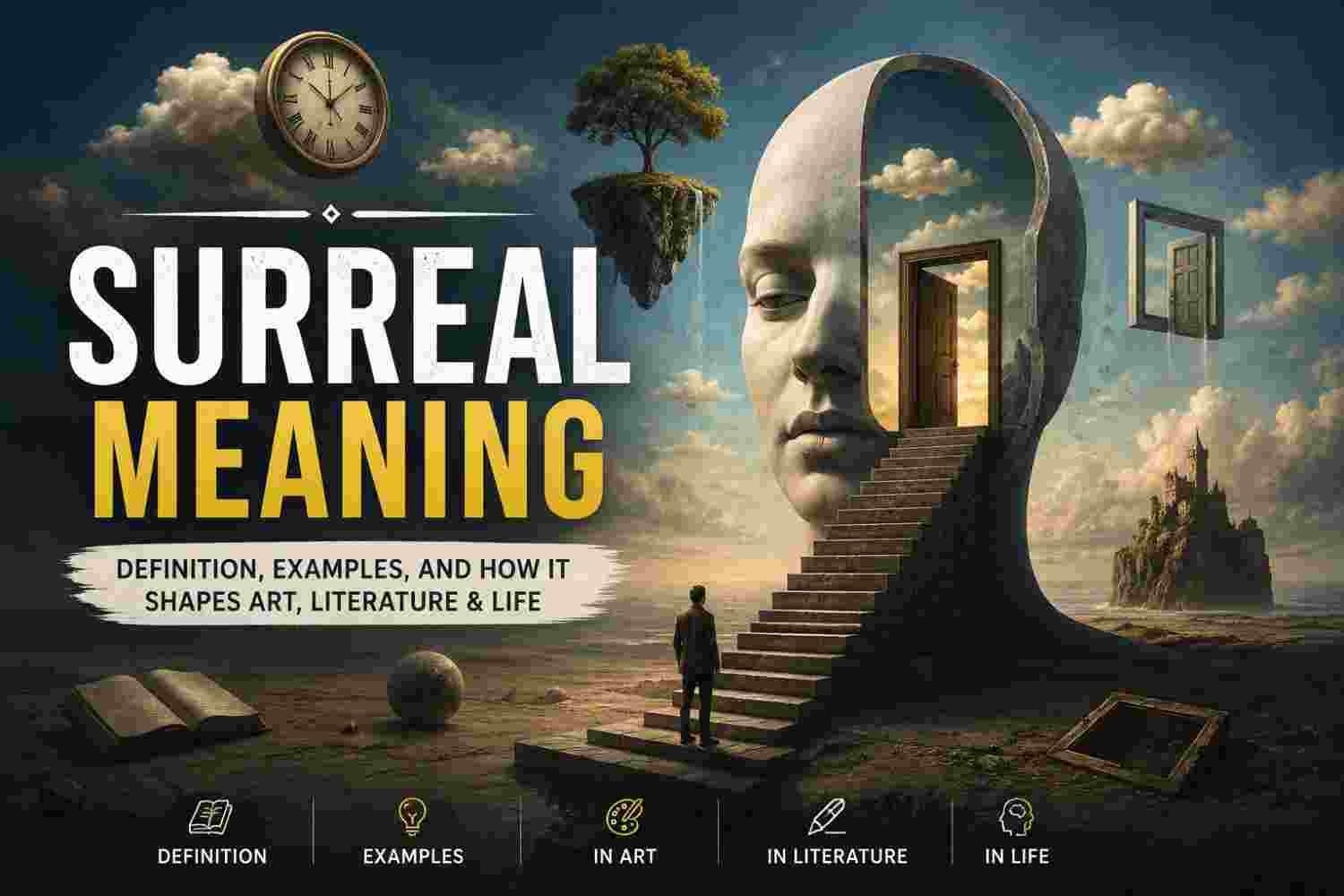
The surreal meaning centers on something that feels bizarre, dreamlike, or irrational—often blending reality and fantasy in a way that disorients you. Merriam-Webster defines “surreal” as “marked by the intense irrational reality of a dream.” When an experience seems to defy logic, the ordinary rules of life feel suspended, and you land squarely in surreal territory.
A surreal moment might fuse familiar objects with impossible scenarios. Imagine a silent city street filled with floating umbrellas, or a conversation where words turn into visible shapes. That jarring mix of the known and the unimaginable is the heart of the surreal meaning. It isn’t simply odd; it’s reality tilted just enough to make you question what’s real.
The Origin of the Word Surreal (and Surrealism)
The term “surreal” sprouted from the early 20th-century art movement Surrealism. French poet Guillaume Apollinaire first coined surréaliste in 1917, and writer André Breton later launched the official Surrealist Manifesto in 1924. The movement aimed to unlock the unconscious mind, letting dreams and raw instinct spill directly onto canvas or paper without rational censorship.
Surrealism gave the surreal meaning its artistic and philosophical weight. Artists like Salvador Dalí painted melting clocks in barren landscapes, creating a visual shorthand for the word. The Tate museum notes that Surrealism sought to “resolve the previously contradictory conditions of dream and reality.” This legacy infuses the modern surreal meaning with a sense of the uncanny—the familiar twisted into something strangely impossible.
How Surreal Differs from Unreal or Dreamlike
People often swap surreal, unreal, and dreamlike as if they are identical. They aren’t. Understanding the differences sharpens your language and prevents the misuse that weakens the surreal meaning.
| Term | Definition | Connotation | Example |
| Surreal | Bizarre, irrational, mixing reality with the impossible in a disorienting way | Unsettling, wonder-inducing, psychologically charged | Walking through a library where books whisper your thoughts feels surreal. |
| Unreal | So extraordinary or unbelievable that it seems fake | Amazement, shock, sometimes disbelief | The athlete’s record-breaking sprint felt unreal to the crowd. |
| Dreamlike | Having the hazy, fluid quality of a dream, often pleasant | Soft, detached, gentle | The misty morning garden had a dreamlike calm. |
| Bizarre | Very strange or unusual, often without the layered depth of the surreal | Weird, curious, sometimes comical | His hat made of live goldfish was simply bizarre. |
The surreal meaning always carries an undertone of psychological tension—a quiet alarm at seeing the illogical trespass into the real world. Unreal can just mean incredible, dreamlike often suggests a soothing blur, and bizarre may be merely odd. Surreal hits deeper.
Surreal in Art: From Dalí to Modern Visuals
Visual art remains the most recognizable home for the surreal meaning. Dalí’s The Persistence of Memory drapes clocks over branches like tired fabric, denying time its rigid authority. René Magritte’s The Treachery of Images declares “This is not a pipe” beneath a meticulously painted pipe, pulling language and reality apart.
Contemporary creators push the surreal meaning further through digital manipulation and AI-generated imagery. Photographers like Brooke Shaden construct dreamscapes where women float in flooded rooms or wear dresses made of clouds. These modern works keep the Surrealist heartbeat alive: the desire to shake you out of comfortable perception and hint at hidden layers beneath daily life.
Surreal Meaning in Literature and Film
Writers and filmmakers weaponize the surreal meaning to yank audiences out of predictable narrative. Franz Kafka’s The Metamorphosis opens with a man turned into a giant insect—no explanation, no fanfare. That cold, factual delivery of the impossible magnifies the surreal horror.
In cinema, David Lynch builds entire worlds saturated with surreal meaning. A scene in Mulholland Drive features a tiny elderly couple scurrying under a door, terrifying you without rational cause. Haruki Murakami’s novels routinely have fish falling from the sky or people conversing with sheep. These stories don’t explain the weirdness; they let you sit in its unsettling magic, which is exactly how the surreal meaning functions in narrative.
Everyday Surreal: How We Use It in Conversations
You’ve likely said something was surreal without a second thought. That’s because modern language borrows the surreal meaning to label moments where emotions collide with improbable circumstances. Running into a childhood friend in a foreign airport when you were just thinking of them feels surreal. Standing in your emptied childhood home after your parents move away carries that same disorienting charge.
People also reach for the surreal meaning during collective upheaval. Empty grocery shelves during a global crisis, silent city centers, or mask-covered faces in familiar spaces create a shared sense of life slipping into a strange dream. The word works because it instantly conveys that weird intersection of deep familiarity and utter strangeness.
The Psychology Behind Surreal Experiences
Why does the surreal meaning resonate so powerfully? Psychology offers clues. A paper in Psychology of Aesthetics, Creativity, and the Arts suggests that surreal imagery jolts the brain’s pattern recognition systems. When reality breaks expected rules, your mind scrambles to reconcile the mismatch, heightening both attention and emotion.
That state of cognitive dissonance can feel uncomfortable, fascinating, or both. Surreal moments often bypass your logical filters and strike older, more instinctive parts of the brain. This is why a strange dream can haunt you all day. The surreal meaning isn’t just a linguistic quirk; it points to how you process reality when the script flips without warning.
Famous Surreal Quotes and Their Deeper Meaning
Quotes from Surrealist artists and thinkers illuminate the surreal meaning from inside the movement. André Breton wrote, “The mind which plunges into Surrealism relives with glowing excitement the best part of its childhood.” He captured how the surreal unlocks a state of raw wonder most adults bury.
Salvador Dalí famously said, “Surrealism is destructive, but it destroys only what it considers to be shackles limiting our vision.” That refusal to accept tidy reality remains central to the surreal meaning. Even popular culture echoes this: comedian Steven Wright deadpans, “I woke up and my house was on fire. My first thought was, ‘I hope the fire doesn’t wake my parents.’” The joke lands because it mirrors the calm illogic of a genuine surreal moment.
Surreal Synonyms and When to Use Them
Sometimes you need a near-synonym without fully trading away the surreal meaning. Here is a quick field guide:
- Uncanny – Best when something familiar feels eerily wrong, like a robot with too-human eyes. Sigmund Freud’s concept of the unheimlich sits behind this word.
- Fantastic – Carries more wonder and impossibility, often in a magical sense, with less psychological weight.
- Hallucinatory – Emphasizes perception distortion, useful for describing fever dreams or drug-induced states.
- Oneiric – A rare, precise term meaning “relating to dreams,” perfect for a film bathed in dream logic.
- Phantasmagoric – Ideal for a constantly shifting, bizarre sequence of images, like a surreal carnival scene.
Choose uncanny for quiet dread, phantasmagoric for visual chaos, and surreal when you need that precise blend of impossible logic and emotional disorientation.
Common Mistakes When Using Surreal (and How to Avoid Them)
Even careful speakers dilute the surreal meaning. One common mistake is using it as a simple upgrade for “weird.” Your neighbor’s neon-green lawn flamingo is odd, maybe bizarre, but not surreal unless it starts reciting poetry. Surreal demands an internal conflict—real and unreal colliding.
Another pitfall is slapping “surreal” onto any exciting event. Winning a raffle feels thrilling or lucky. Without a layer of improbable, dreamlike strangeness, the word misses its mark. Save the surreal meaning for moments that genuinely tilt your grip on what seems possible. The word packs its punch only when the situation feels as though it belongs in a painting where clocks melt.
How to Describe a Surreal Moment Like a Writer
Strong writing makes the surreal meaning tangible. Focus on sensory details that clash. Mention a sound that has no visible source, a shadow that moves the wrong way, or a clock ticking backward. Pair the impossible with the mundane: a man calmly eating soup while his chair floats two inches off the floor.
Set the scene with concrete, ordinary objects first—a kitchen, a bus stop—then disturb one element. That contrast creates the necessary friction. Describing the character’s physical reaction also helps. A tight throat, slowed perception of time, or the sensation of watching oneself from a distance all signal the surreal meaning without ever having to use the word.
The Power of Surreal Imagery in Marketing
Brands tap into the surreal meaning to grab attention and etch messages into memory. A perfume ad might show a woman walking upside down beneath a lake’s surface, breathing normally. That impossible image stops the scroll and links the product to a sense of unbounded possibility.
Surreal marketing works because it short-circuits logic and aims straight for emotion. Viewers remember the strange image longer than a plain product shot. The technique trades on the same principle as Surrealist art: break the expected pattern, and you own a little piece of someone’s mind. Done well, it doesn’t confuse—it captivates.
Surreal Meaning in Different Languages and Cultures
Not every language carries the exact weight of the surreal meaning in a single word, but many cultures embrace the concept. The Japanese aesthetic of yūgen evokes a profound awareness of the mysterious, tinged with sadness and beauty—close kin to the quieter side of the surreal. Czech animator Jan Švankmajer builds surreal films rooted in Eastern European folklore, where objects gain unsettling lives of their own.
Latin American magical realism merges the everyday with the extraordinary so seamlessly that flying women and talking ghosts feel natural. Authors like Gabriel García Márquez don’t label the miraculous as surreal; they present it as fact. This cultural variation reminds you that the surreal meaning depends partly on what a society accepts as possible.
Frequently Asked Questions
What does surreal mean in simple words?
Surreal describes an experience that feels like a strange dream, mixing what’s real with what seems impossible in a way that disorients you.
Can a situation be surreal but not dreamlike?
Yes. A surreal moment can feel hyper-real and sharp rather than soft or hazy. It’s the clash of rational and irrational that defines the surreal meaning, not the foggy quality of a dream.
What’s the difference between surreal and surrealistic?
Surrealistic typically refers to the style or techniques of the Surrealist art movement. Surreal describes the quality of any experience or object that feels bizarrely irrational, with or without a direct link to the art movement.
Is surreal always positive?
No. The surreal meaning covers both wonder and unease. A peaceful floating city might feel magical, while an empty hospital at noon with flickering lights feels deeply unsettling. Both are surreal.
How did surrealism influence the word’s meaning?
Surrealism sought to express the unconscious mind without rational control. It gave us the vocabulary and imagery—melting clocks, impossible creatures—that now shape the everyday surreal meaning.
What’s a good example of a surreal moment?
Watching a deer walk calmly through a subway car while commuters quietly read their newspapers. The complete absence of expected panic makes the ordinary setting feel profoundly surreal.