Selah Meaning: The Mystery Word Hiding in Plain Sight
Be honest — you’ve skimmed right past it. Seventy-four times, one strange little word sits at the edge of Bible verses, and most readers glide over it as if it were a printing error.
That word is Selah. Stranger still, the translators of nearly every English Bible refused to touch it.
In the next few minutes, you’ll learn where this word came from, what ancient temple musicians did when they saw it, and how a 3,000-year-old pause can rescue your prayer life from autopilot. No guesswork dressed up as fact — just what manuscripts and linguists genuinely reveal.
What Does Selah Actually Mean?
Open Psalm 3 and you’ll hit it within two verses. “Selah.” No definition. Often no footnote. Just a full stop that somehow feels heavier than every other full stop on the page.
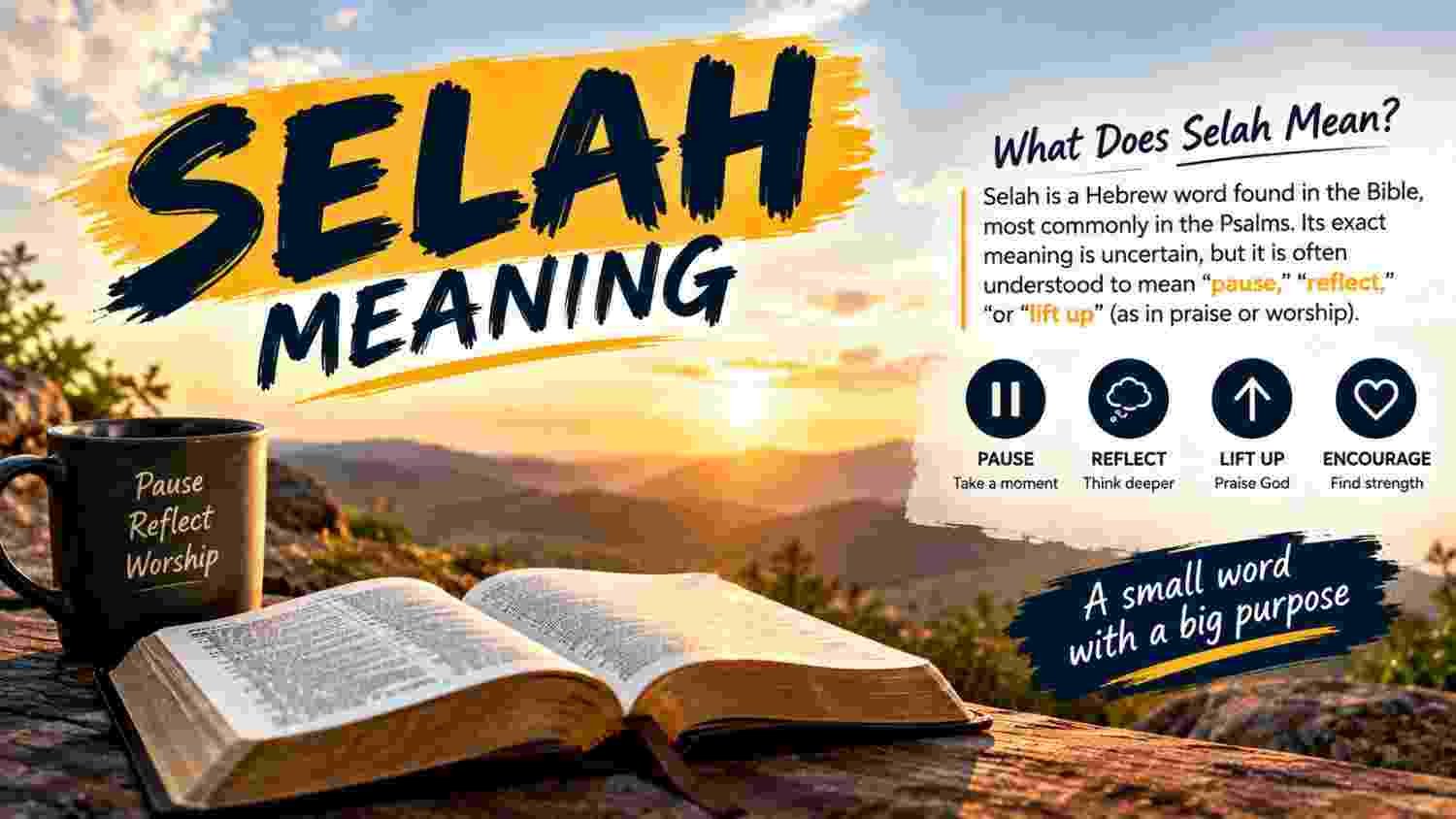
Here is the honest answer: nobody on earth knows its exact meaning — and that includes the experts. Selah (Hebrew סֶלָה, pronounced see-lah) appears only inside poetry, only in worship settings, and only where deep emotion runs through the text.
What scholars agree on is what it does, not what it says. It works like a road sign planted between verses, telling the reader or singer: something weighty just happened, so slow down.
The Three Hebrew Clues Behind the Word
Linguists have traced Selah back to several possible Hebrew roots, and each one paints a slightly different picture:
- Salal — “to lift up, exalt.” This makes Selah a cue to raise voices, instruments, or praise to a higher level.
- Salah — “to hang, suspend, or weigh.” That reading turns Selah into a commanded silence — a holy pause in the music.
- Le’almin — “forever,” the rendering used by the ancient Aramaic Targums, treating Selah as an affirmation of eternal truth.
Pick any root you like; the destination is the same. Stop, lift, and let the previous line sink all the way in.
Why Translators Refused to Touch It
The Septuagint — the Greek Old Testament completed around the 2nd century BCE — had already shrugged, rendering Selah as diapsalma, roughly “an interlude.” The Latin Vulgate gave up differently and printed semper, meaning “always.”
When translators living far closer to the source than we are couldn’t crack it, modern Bible teams made a brave call: they left the Hebrew word standing untranslated in the English text.
That decision is the only reason your Bible still says “Selah” today, while every other obscure biblical term got smoothed away centuries ago.
Where Selah Shows Up: The Hard Numbers
| Location | Occurrences | Key Detail |
|---|---|---|
| Book of Psalms | 71 | Spread across 39 of the 150 psalms |
| Habakkuk chapter 3 | 3 | Inside the prophet’s psalm-like prayer |
| Total | 74 | First appearance: Psalm 3:2 |
Look closer at the distribution and a pattern jumps out. Forty-seven occurrences cluster in Psalms 1–72 — the older, Davidic heart of the book — while only 24 appear in the final third. That skew suggests Selah belonged to an older, more formal temple tradition that gradually faded.
Even more telling, some psalms repeat it. Psalm 3 carries three Selahs, splitting David’s rawest prayer into three breathing spaces: fear, faith, and victory — each one handed its own silence.
The 3 Leading Theories, Explained Simply
Theory 1: A Musical Interlude
Most scholars land on this one. The Psalms were Israel’s hymnbook, sung with harps and lyres in the temple, and Selah likely told the musicians: play alone now, while the singers rest. Think of it as the ancient, reverent ancestor of the instrumental break in your favorite song.
Theory 2: A Signal to Lift Up Praise
The salal (“to lift”) root supports a very different picture. When the choir reached a Selah, the whole congregation may have been meant to erupt — lifting voices, hands, and hearts in response to the truth just sung.
In this reading, Selah isn’t silence at all. It’s a spark. A trigger for praise at exactly the moment the words deserve it.
Theory 3: A Pause for the Heart
The most pastoral reading comes from salah, “to weigh.” The singers stop so the listeners can mentally weigh what was just declared. God has just been called a shield, a healer, a fortress — so pause, and actually feel the weight of that.
This is the interpretation that survived into synagogues and churches alike — and honestly, it’s the one that still preaches best today.
How Selah Worked in Ancient Temple Worship
Picture a Jerusalem temple service around 950 BCE. Levites on stringed instruments, a cantor chanting David’s words, worshippers packed into the courts. Suddenly, mid-psalm, everything stops.
That silence wasn’t awkward — it was engineered. Within the performance, Selah quietly did four jobs at once:
- It marked stanza breaks, helping congregations memorize massive psalms in sections.
- It gave instruments room to answer the voice, creating call-and-response worship.
- It framed the emotional peaks — after a line like “He forgives all your sins,” the pause says: sit with that.
- It kept the service from racing past its own holiness.
The Babylonian Talmud even links Selah with eternity, suggesting the word carried doctrinal weight, not just musical instruction. One small word, holding both a melody and a message.
What Selah Means for You Today
Here’s where an ancient scribal mark becomes unexpectedly practical. We live in the most distracted era in human history, and Selah is God’s built-in distraction killer, printed right into Scripture.
- Read it as an instruction, not decoration. Every time you meet Selah, stop for ten full seconds before the next verse.
- Reread the previous line aloud. Repeat it until it stops sounding familiar and starts sounding personal.
- Pray with built-in pauses. Instead of rushing through requests, end a sentence with your own Selah — silence first, then listen.
- Journal the pause. Write one sentence on why the last verse matters to you before moving on.
Try it with Psalm 46. Verse 7 ends with Selah, and three verses later comes the famous command: “Be still, and know that I am God.” The stillness was rehearsed before it was ever written down.
Selah in Modern Culture
The word never really died. A Grammy-nominated gospel duo took Selah as their name, Kanye West built a track around it on his 2019 album Jesus Is King, and rappers have borrowed it as a mic-drop ending to verses.
It has also slipped into baby-name charts, wellness blogs, and meditation apps. A word that once paused temple choirs now pauses busy, screen-tired people — proof the concept ages better than the mysteries around it.
Frequently Asked Questions About Selah
How many times does Selah appear in the Bible?
Selah appears 74 times: 71 in the Book of Psalms and 3 times in Habakkuk chapter 3. The very first occurrence is Psalm 3:2, and it never appears anywhere else in Scripture.
Was Selah a musical note?
Not a note in the modern sense. Scholars describe it as a performance cue — an interlude for instruments, a rest for singers, or a signal to lift the volume. It’s closer to a conductor’s instruction than to sheet-music notation.
Why didn’t translators translate Selah?
Because the meaning was already lost before Jesus’ time. Ancient versions disagreed — the Septuagint said “interlude,” the Vulgate said “always,” the Targums said “forever” — so English translators prudently kept the original Hebrew word in place.
Does Selah mean the same thing as “Amen”?
Not exactly. “Amen” affirms agreement with what was said, while Selah most likely directs how it was said — with a pause or a lift. Still, the Targum’s “forever” reading gives it an affirming, eternal flavor that feels similar in worship.
Is Selah the last word of the Book of Psalms?
No. The Psalms close with Psalm 150’s explosion of praise: “Let everything that has breath praise the LORD.” Selah appears inside individual psalms, never as the book’s finale.
Can I use Selah as a baby name?
Absolutely, and many parents now do. It carries a beautiful built-in meaning — “pause and reflect” — while still sounding modern. It works for boys or girls, though it’s currently rising faster as a girl’s name.
How do I explain Selah to a child in one sentence?
Say this: “When you see Selah, it means stop and think about how amazing God is.” Kids grasp it instantly — usually faster than adults do.
Final Word: Stop Skipping the Pause
Selah may never get a dictionary definition this side of heaven, and maybe that’s the point. A word built entirely around mystery demands that you slow down — you can’t rush it, and you can’t skim it.
So here’s your insider tip: tonight, read only Psalm 3. It’s eight verses long and contains three Selahs. Pause ten seconds at each one, reread the verse before it, and notice what happens to your heart.
Seventy-four pauses are sitting in your Bible right now, patiently waiting. Most people never take a single one. Be the reader who does — and you’ll understand why the ancients considered silence itself an act of worship.