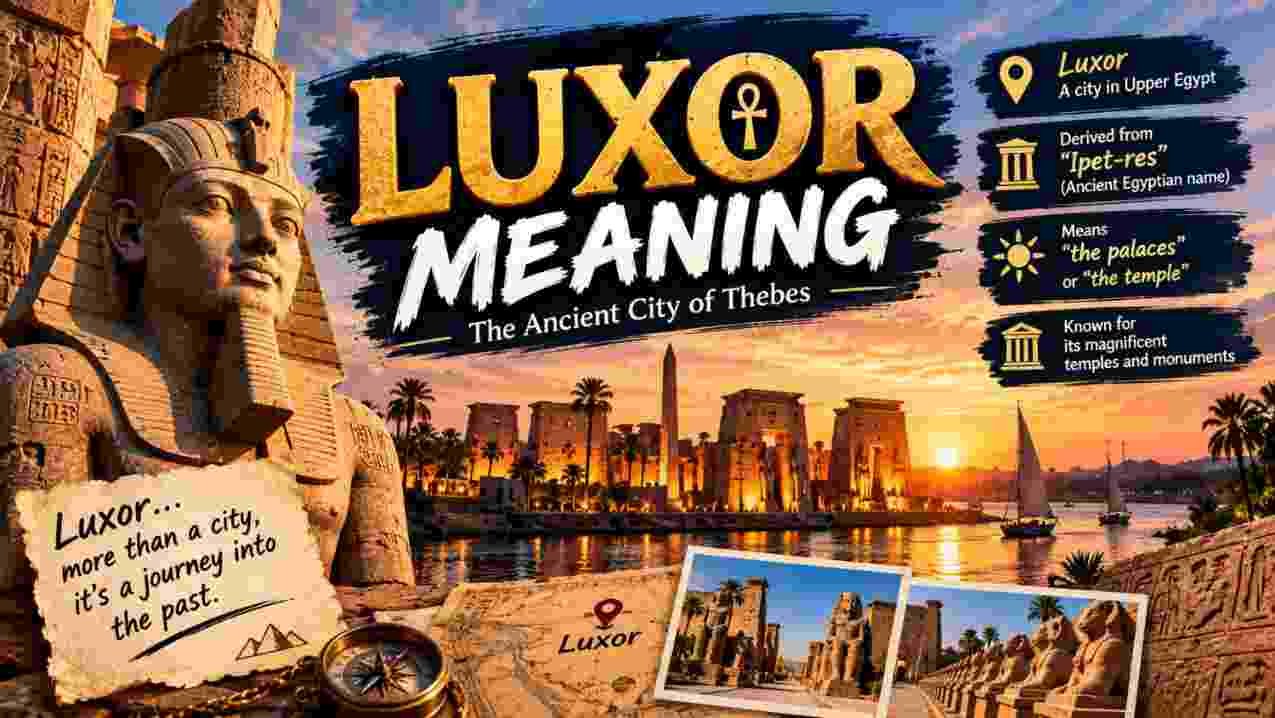
Luxor Meaning: The Powerful Story Hidden Inside One Famous Word
Most people say the word “Luxor” without knowing it literally means “The Palaces.” Yes, one of the most famous names on Earth carries a royal secret that goes back over a thousand years.
Maybe you heard the name in a geography class. Maybe you saw the glowing black pyramid in Las Vegas. Or maybe you spotted “Luxor” on a pencil, a hotel, or a baby name list and wondered what it actually stands for.
By the end of this article, you will know the full Luxor meaning — its Arabic roots, its ancient Egyptian past, its spiritual weight, and why brands across the world keep borrowing this name. Let’s unlock it.
What Does Luxor Mean? The Direct Answer
The name Luxor comes from the Arabic word , which means “The Palaces” or “The Castles.” It is the plural form of “qasr,” the Arabic word for palace or fortress.
Interestingly, the Arabic “qasr” itself traces back to the Latin word “castrum,” meaning a fort or military camp. Roman soldiers once built camps in this Egyptian city, and the name stuck through Arabic, then traveled into English as “Luxor.”
So when you say Luxor, you are literally saying “the palaces.” Few city names on the planet sound this royal by definition.
Quick Breakdown of the Word
- Modern English: Luxor
- Arabic origin: Al-Uqsur (الأقصر) — “The Palaces”
- Root word: Qasr (قصر) — palace, castle, fort
- Deeper root: Latin castrum — fortified camp
- Ancient Egyptian name: Waset — “City of the Scepter”
- Greek name: Thebes
Luxor the City: Where the Name Was Born
Luxor is a real city in southern Egypt, sitting on the east bank of the Nile River. Historians often call it the world’s greatest open-air museum, and honestly, that title is not marketing fluff.
Around 4,000 years ago, this city was called Waset by the ancient Egyptians and Thebes by the Greeks. It served as the glittering capital of Egypt during its most powerful eras, home to pharaohs, priests, and temples that still stand today.
When Arab travelers arrived centuries later, the ruins of massive temples and monuments looked like abandoned royal palaces to them. So they named the place Al-Uqsur — The Palaces — and the modern name Luxor was born.
Why It Was Named “City of the Scepter” by the Ancients
The original name Waset referred to the was scepter, a staff symbolizing power and dominion, carried by gods and pharaohs in Egyptian art. The city was seen as the seat of divine authority on Earth.
Homer, the Greek poet, even called it the “City of a Hundred Gates” in the Iliad because of its enormous gateways and wealth. Power, royalty, and grandeur have been baked into this name from the very beginning.
What Makes Luxor Famous Today
- The greatest religious complex ever constructed by humanity is the Karnak Temple.
- Luxor Temple: A stunning riverside temple lit up beautifully at night.
- Valley of the Kings: Burial site of Tutankhamun and dozens of pharaohs.
- Hot air balloon rides: Sunrise flights over the Nile and ancient ruins.
- Avenue of Sphinxes: A 2.7 km ancient road reopened to the public in 2021.
Luxor as a Name: Meaning for People and Brands
Some parents today pick Luxor as a bold, modern baby name, usually for boys. As a personal name, it carries the meaning of “palace,” “royalty,” “strength,” and “timeless legacy” — a name that sounds both ancient and futuristic at once.
Brands love it for the same reason. The word is short, punchy, exotic, and instantly suggests luxury — partly because “Luxor” accidentally echoes the Latin word “lux,” meaning light, and the English word “luxury.” That double association is pure branding gold.
Famous Uses of the Name Luxor
- Luxor Las Vegas: The iconic pyramid-shaped hotel and casino opened in 1993, topped by the Sky Beam — one of the strongest light beams in the world.
- Luxor pens and stationery: A well-known writing instruments brand, hugely popular across India and Asia.
- Luxor (video game series): A classic puzzle game franchise with an Egyptian theme.
- Luxor Obelisk, Paris: A genuine 3,000-year-old obelisk from Luxor Temple, now standing in Place de la Concorde.
Spiritual and Symbolic Meaning of Luxor
Beyond dictionaries, Luxor holds deep symbolic weight. Ancient Thebes was dedicated to Amun-Ra, the king of Egyptian gods, making the city a spiritual capital, not just a political one.
Many spiritual writers describe Luxor as a symbol of transformation, hidden power, and rebirth. The Valley of the Kings, after all, was designed as a doorway between this life and the next.
In numerology circles, the name Luxor is often linked with leadership energy and ambition. Whether or not you follow such systems, the name undeniably projects authority — it simply sounds like it belongs on a throne.
Luxor Meaning at a Glance: Facts and Figures Table
Here is a clean summary you can scan in ten seconds:
| Aspect | Detail |
|---|---|
| Literal meaning | “The Palaces” (Arabic: Al-Uqsur) |
| Root word | Qasr (palace) → Latin castrum (fort) |
| Ancient names | Waset (Egyptian), Thebes (Greek) |
| Location | Southern Egypt, on the Nile River |
| City population | Roughly 1.3 million (governorate estimate) |
| Age of the city | Over 4,000 years of continuous history |
| UNESCO status | Ancient Thebes listed as World Heritage Site in 1979 |
| Annual visitors | Millions; a core pillar of Egypt’s tourism economy |
Look at that table for a moment. Very few words in any language can claim a documented 4,000-year identity, a UNESCO listing, and a Vegas casino all at once. That mix of ancient depth and modern glamour is exactly why the Luxor meaning fascinates so many people.
Common Confusions About the Word Luxor
People mix up a few things about this name, so let’s clear them fast.
Is Luxor Related to “Luxury”?
Not directly. “Luxury” comes from the Latin luxus (excess), while Luxor comes from the Arabic Al-Uqsur (palaces). The similarity is a happy accident — though marketers exploit it brilliantly.
Is Luxor the Same as Thebes?
Essentially, yes. Modern Luxor sits on and around the ruins of ancient Thebes. Thebes is the old Greek name; Luxor is the modern Arabic-derived name for the same location.
Is Luxor Only a Place Name?
No. Today Luxor works as a city name, a personal name, a hotel, a pen brand, a game title, and more. The place came first; everything else borrowed its shine.
Frequently Asked Questions About Luxor Meaning
What is the exact meaning of Luxor?
Luxor means “The Palaces.” It comes from the Arabic word Al-Uqsur, the plural of qasr (palace), a name given because the city’s giant ancient temples looked like royal palaces.
What was Luxor called in ancient times?
Ancient Egyptians called it Waset, meaning “City of the Scepter.” The Greeks later called it Thebes, the name most history books use for the pharaohs’ capital.
Is Luxor a good baby name?
Yes, if you want something rare and powerful. It suggests royalty, strength, and history. It is uncommon, easy to pronounce in most languages, and carries no negative meaning.
Why is the Las Vegas hotel called Luxor?
The developers built the hotel as a giant black glass pyramid with Egyptian theming, so they named it after Luxor, Egypt’s most famous ancient city, to complete the pharaoh fantasy.
Which language does the word Luxor come from?
It comes from Arabic (Al-Uqsur), which itself borrowed the root from the Latin word castrum, meaning fort. So the name blends Arabic and Latin history in one word.
Is Luxor mentioned in religious texts?
The city, under its older name Thebes (called “No” or “No-Amon”), appears in the Bible in books like Nahum and Jeremiah, referenced as a mighty city of Egypt.
Why is Luxor called an open-air museum?
Because ancient monuments — Karnak, Luxor Temple, the Colossi of Memnon, royal tombs — stand in the open across the city, letting visitors walk through history without entering a building.
Final Verdict: Why This One Word Still Rules
Here is the insider takeaway: Luxor is not just a label on a map. It is a 4,000-year-old brand that literally means “The Palaces” — and it has never stopped meaning power, from pharaohs to Vegas neon.
If you are naming a child, a business, or a product, few words deliver instant prestige like this one. And if you ever get the chance to visit the real Luxor, take the sunrise balloon ride. Watching the sun climb over the Valley of the Kings explains this name’s meaning better than any dictionary ever could.