Medusa Tattoo Meaning: The Powerful Story Behind the Gaze
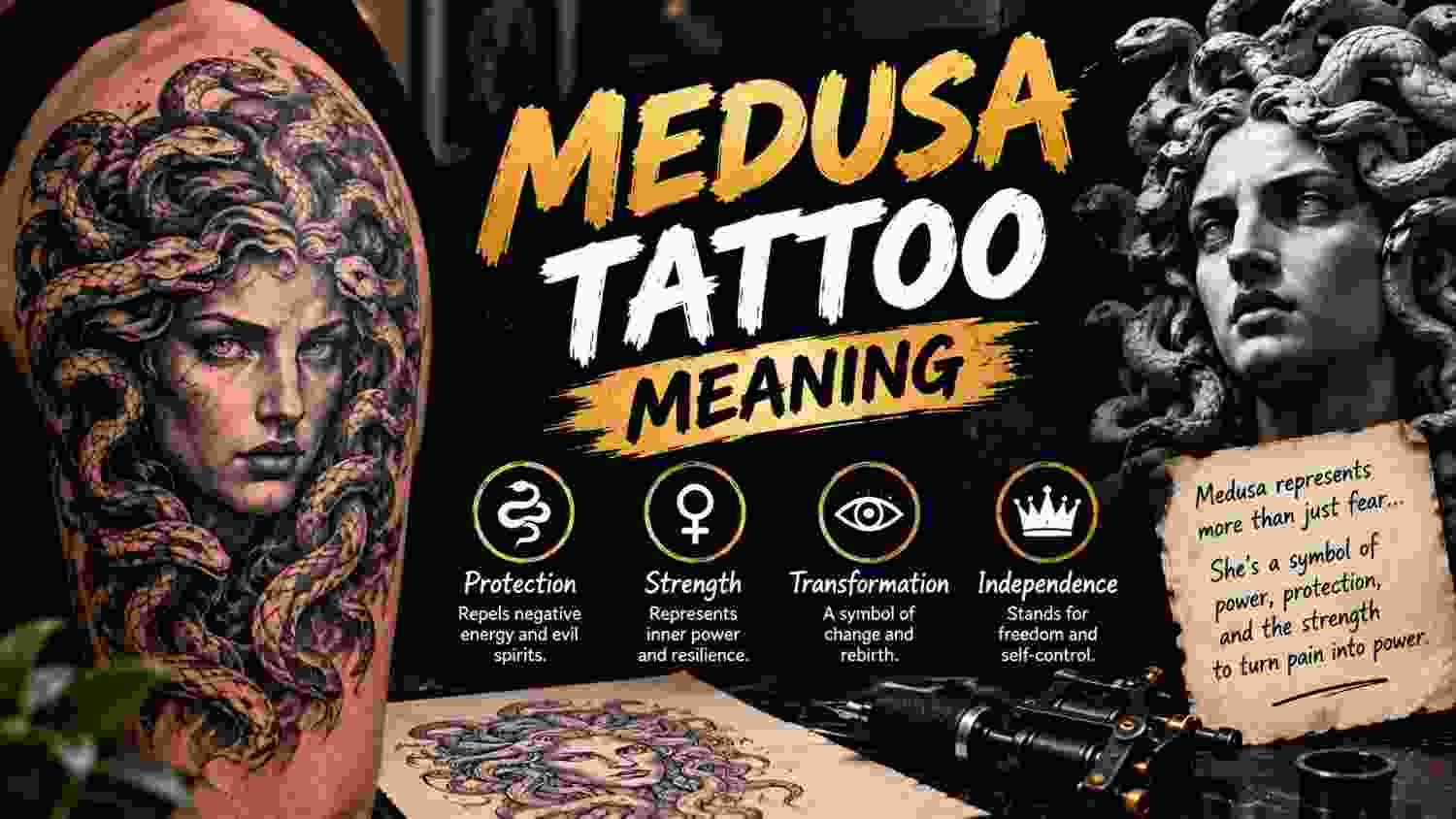
A Medusa tattoo is rarely chosen for beauty alone—it often carries a story the wearer refuses to hide. Behind the snakes and stone-turning stare lies a symbol of survival, protection, anger, transformation, and reclaimed power.
There is no single medusa tattoo meaning that fits everyone. This guide separates ancient myth from modern symbolism, then explains how the eyes, snakes, color, placement, and artistic style can reshape the message.
What Does a Medusa Tattoo Mean?
In its broadest sense, a Medusa tattoo represents power shaped by adversity. It may show that someone faced judgment, betrayal, abuse, or loss and chose self-protection rather than shame.
Others simply admire Medusa as a guardian, rebellious woman, tragic character, or image of dangerous beauty. Personal intention always matters more than assumptions made by strangers.
| Common interpretation | Typical design clue | Possible message |
|---|---|---|
| Survival | Scars, tears, cracked stone | “I was not destroyed.” |
| Protection | Direct gaze, striking snakes | “Respect my boundaries.” |
| Feminine power | Crown, jewelry, calm face | “My strength is mine.” |
| Transformation | Flowers, shedding snakes | “I became someone new.” |
| Anger at injustice | Dark shading, red accents | “I will not stay silent.” |
| Beauty and danger | Soft portrait, active serpents | “Softness is not weakness.” |
This is a reading guide, not a fixed dictionary. Two nearly identical portraits can carry completely different histories for their owners.
The Myth That Changed Medusa’s Symbolism
The older Greek tradition
In early Greek accounts, Medusa was one of three Gorgon sisters and the only mortal. The hero Perseus killed her by looking into a reflective shield rather than meeting the gaze that turned people to stone.
Her severed head remained powerful after death, and Athena placed it on her shield or aegis. That detail links the Gorgon to apotropaic protection—an image intended to repel danger or evil.
Ovid’s tragic version
The Roman poet Ovid tells a darker version in Metamorphoses. Neptune violates Medusa in Minerva’s temple, after which Minerva transforms Medusa’s hair into snakes.
Many modern readers see victim-blaming in this account. It has helped make Medusa a symbol of survivor solidarity, although ancient sources do not present one consistent origin story.
Why the version matters
A warrior-like Gorgon can emphasize supernatural defense. A tearful human portrait may instead focus on betrayal, grief, and the cost of being misunderstood.
The distinction also prevents a harmful assumption: not every wearer is disclosing trauma. Never demand the private story behind someone else’s tattoo.
7 Powerful Medusa Tattoo Meanings
1. Survival and reclaimed control
Some survivors use Medusa to reverse a painful narrative. A scarred face, broken chain, or unwavering gaze shifts attention away from what happened and toward the authority reclaimed afterward.
2. Feminine strength without permission
Medusa combines beauty with anger, danger, and self-defense. She appeals to people who reject the idea that women must remain harmless or agreeable to deserve respect.
3. Protection from harm
Gorgon faces appeared on ancient shields, armor, and buildings as protective emblems. Forward-facing eyes and alert snakes give a modern design the feeling of permanent armor—and a visible warning.
4. Transformation after hardship
Snakes suggest renewal because they shed their skin. Add flowers, butterflies, or moon phases, and the tattoo can express recovery, emotional growth, and an identity rebuilt with intention.
5. Anger at injustice
Medusa’s stare gives dismissed anger a visible form. Dark blackwork, bared fangs, storm imagery, or red accents can show that rage exposes wrongdoing and guards hard-won boundaries.
6. Independence and boundaries
The stone-turning gaze naturally conveys distance, self-rule, and consequences. A calm face with controlled snakes can send a quieter message: access is not forbidden, but trust must be earned.
7. Beauty and danger in one image
Medusa holds attraction and threat at the same time. A graceful face surrounded by aggressive serpents suits anyone who embraces contradictions and refuses to be reduced to one tidy identity.
How Design Details Change the Message
Face, gaze, and expression
The face is the emotional center of the tattoo. Even a small change can move the meaning from grief to fury, or from vulnerability to total control.
- Closed eyes: peace, restraint, or contained power
- Direct eye contact: confidence, vigilance, and warning
- Tears: grief, betrayal, survival, or healing
- Calm expression: quiet self-mastery
- Fangs or open mouth: rage and immediate defense
Snakes and supporting symbols
Resting snakes imply controlled strength; striking snakes feel volatile and defensive. A few carefully chosen symbols can add depth without overcrowding the portrait.
- Roses: beauty surviving pain
- Daggers: betrayal or decisive separation
- Butterflies: rebirth and emotional change
- Mirrors: self-knowledge and Perseus’s strategy
- Broken chains: freedom from control or shame
- Moon phases: intuition, cycles, and renewal
Color and tattoo style
Black-and-grey realism feels serious and timeless, while fine-line work appears delicate. Traditional tattooing uses bold outlines and limited colors to turn Medusa into a clear, lasting emblem.
Red suggests rage or warning; green connects the portrait to serpents and nature. Gold can imply sacred power or victory, while purple creates a mystical, self-possessed mood.
Best Placement for a Medusa Tattoo
Placement affects visibility and detail. Large areas give the artist room to preserve facial emotion, clean scales, and separation between the snakes.
- Forearm: visible and assertive
- Shoulder: easy to extend into a sleeve
- Thigh: private when desired, yet spacious
- Back: suited to a full mythological scene
- Chest: personal, protective, and intense
- Calf: naturally fits a vertical portrait
Tiny designs can blur as ink ages. For a smaller tattoo, use bold eyes, fewer snakes, strong negative space, and a silhouette readable from a distance.
Before You Choose Your Design
Avoid copying a viral image without understanding why it appeals to you. Use this process to create artwork that feels personal rather than borrowed.
- Write the meaning in one sentence. Give your artist an emotional target.
- Choose the mythic angle. Guardian, survivor, monster, tragic figure—or a blend?
- Select one dominant emotion. Calm power and explosive rage need different faces.
- Limit extra symbols. Two purposeful additions beat six unrelated ones.
- Inspect healed work. Fresh photos do not show how fine details settle.
- Request an original composition. References should guide, never duplicate.
Frequently Asked Questions
Is a Medusa tattoo a symbol for sexual assault survivors?
It can be. Many survivors connect Medusa with survival, protection, and resistance to victim-blaming through modern readings of Ovid. That meaning remains personal and should never be treated as automatic disclosure.
Is getting a Medusa tattoo disrespectful?
Not inherently. Learning the mythology, commissioning original artwork, and avoiding mockery show care. Copying another person’s private memorial is a different matter.
Does a Medusa tattoo mean someone is dangerous?
No. A threatening gaze may represent defensive strength or danger already survived, not a wish to harm anyone. The wearer’s intention carries more weight than stereotypes.
What does a Medusa tattoo mean on a woman?
Common readings include feminine autonomy, survival, anger at unfair treatment, and freedom from expectations. It may also express a simple love of mythology and portrait art.
Can a man get a Medusa tattoo?
Yes. Protection, resilience, mortality, transformation, and mythological art are not limited by gender. The message comes from personal intention and design choices.
What do Medusa’s snakes represent?
They often represent renewal, instinct, danger, wisdom, or protection. Calm serpents show discipline, striking snakes create warning, and shedding skin makes rebirth especially clear.
Should Medusa’s eyes be open or closed?
Open eyes suggest confrontation, vigilance, and active defense. Closed eyes feel reflective and may show peace, restraint, or power that no longer needs to prove itself.
Final Verdict: Make the Meaning Your Own
The strongest medusa tattoo meaning is not the one receiving the most attention online. It is the one that still feels honest after trends fade—whether it expresses survival, protection, independence, change, or fascination with myth.
Start with the emotion, then build the face, snakes, symbols, and placement around it. A skilled tattoo artist can turn those choices into a powerful composition that remains readable as it ages.