Authentic Meaning: 7 Smart Proven Secrets to Stop Faking Your Life
You wake up, paste on a smile, say what people expect, and go to bed wondering why everything feels flat. That quiet ache is not burnout. It is the gap between who you are and who you pretend to be. This guide strips the authentic meaning down to something you can actually use—no philosophy lecture, no vague self-help fluff.
Most people never define the authentic meaning for themselves. They chase a version of real that others approve of. That is the first trap. You cannot build an honest life on borrowed definitions.
You will leave this page with seven smart, proven secrets that make real living feel natural again. Not perfect. Not performative. Just true enough to breathe in.
Why the Authentic Meaning Keeps Slipping Away
Authentic meaning is not a fixed label you earn once. It is a living signal you tune into daily. The problem starts when society teaches you to ignore that signal. From childhood, you learn that fitting in feels safer than standing out.
By the time you hit adulthood, the mask has become automatic. You laugh at jokes that sting. You agree with plans you hate. You soften your opinions until they vanish. Each tiny betrayal tells your nervous system one thing: your real self is not welcome here.
This is why the authentic meaning feels slippery. You think you need to find yourself, but really you need to stop hiding yourself. The search for authenticity becomes another performance when you treat it as a destination instead of a daily practice.
The Social Mirror Problem
Most people look at their reflection through someone else’s eyes. A parent wants you stable, a partner wants you agreeable, an algorithm wants you clickable. None of them are evil. But none of them can give you the authentic meaning you crave.
The social mirror problem shows up in four quiet ways.
- You perform confidence at work while feeling small.
- You nod through conversations to avoid conflict.
- You post a highlight reel that hides the messy middle.
- You choose safe paths because “realistic” sounds smarter than “alive.”
The Psychology Behind Authentic Meaning
Psychologists have argued about authentic meaning for decades, but one thread holds firm. Realness is congruence between your inner experience and your outward behavior. The smaller the gap, the calmer your mind becomes. The bigger the gap, the more anxiety, resentment, and fatigue you carry.
Carl Rogers called this the difference between the real self and the ideal self. You do not need a perfect self. You need a self you are allowed to reveal without immediate correction. That permission often has to come from you before it can come from others.
Why Hiding Is Exhausting
When you hide a thought, your brain must run two scripts at once. One script says what you truly feel. The other script says what is safe to say. That split attention drains glucose, weakens memory, and makes ordinary conversations feel like high-stakes negotiations.
You might notice these signs.
- You rehearse sentences before speaking.
- You replay interactions looking for mistakes.
- You feel tired even after easy social events.
- You resent people who simply say what they think.
7 Smart Proven Secrets to Reclaim Authentic Meaning
These secrets are not theories. They are small, repeatable moves that close the gap between your inner truth and your daily choices. Start with the one that feels easiest, not the one that feels most impressive.
1. Define Your Non-Negotiables Before the Room Speaks
Authentic meaning grows from clear values. Write down three things you will not trade for approval. They could be honesty, creative freedom, or time alone. When a choice arrives, you already know which answer is real.
Pick one value that protects your energy, one that protects your honesty, and one that protects your future self. That small list becomes your compass. Without it, every room you enter will decide who you are for you.
2. Let Small Disagreements Teach You Big Truths
You do not need to start with dramatic confessions. Start with a restaurant you dislike or a movie everyone praised. Say, “That was not for me.” That tiny refusal builds the muscle you need for bigger moments.
Small disagreements feel safe because the stakes are low. But the signal you send yourself is huge. You learn that disagreement does not end connection. That lesson rewires years of people-pleasing.
3. Stop Calling It Overthinking and Start Listening
That churning feeling is not always anxiety. Sometimes it is your values sending a warning. Instead of silencing the inner voice, ask it one question: What am I pretending not to know? The answer usually arrives fast.
Your body often knows the truth before your mind does. A tight chest, a forced laugh, a sudden urge to leave the room. Those are not flaws. They are feedback pointing you back to authentic meaning.
4. Make Your Private Life Match Your Public Story
Authentic meaning collapses when your alone time contradicts your online image. If you post about calm mornings but scroll until 2 a.m., the gap widens. Choose one private habit that matches the person you claim to be.
You do not need to overhaul everything overnight. Pick one habit that feels honest and doable. Maybe you actually take ten minutes of quiet in the morning. Maybe you stop pretending you read books you never open. Small consistency builds self-trust.
5. Use the Three-Question Filter
Before you say yes, run it through this filter. Does this align with my values? Would I do it if no one praised me? Will I respect myself tomorrow? If two answers are no, the authentic answer is likely no too.
This filter cuts through the noise fast. You do not have to debate every request for hours. Three questions give you permission to honor your limits without writing a long apology.
6. Find People Who Reward Your Real Voice
You cannot stay real in a room that punishes honesty. Look for the person who leans in when you speak plainly. Protect that relationship. One safe person can rewire your sense of permission faster than ten self-help books.
Authentic meaning is not built in isolation. It is built in spaces where your unedited self is met with curiosity instead of correction. Seek those spaces. Create them when you can. They are rare, but they are enough.
7. Accept That Some People Will Be Disappointed
The price of authentic meaning is occasional disapproval. Someone loved the old, agreeable version of you. That person may pout, guilt-trip, or distance themselves. Let them. Your nervous system will thank you for choosing alignment over applause.
Not everyone gets to come with you into your real life. That is not a failure. It is a filter. The people who stay will know you, not the mask. And that is the only connection worth building.
What Authentic Meaning Changes in Your Daily Choices
Once you stop performing, decisions become simpler. You spend less energy guessing what others want and more energy building what you actually value. That shift shows up in small ways before it changes your career or relationships.
| Area | Fake Self Behavior | Authentic Self Behavior |
|---|---|---|
| Work | Agreeing to every task, hiding questions, copying others’ tone | Asking direct questions, admitting skill gaps, saying no to misaligned projects |
| Relationships | Avoiding hard talks, over-apologizing, performing affection | Naming needs early, tolerating disagreement, showing affection honestly |
| Identity | Chasing trends, filtering photos, rehearsing opinions | Wearing what fits, sharing unpolished thoughts, changing your mind openly |
| Rest | Filling silence with distractions, ignoring exhaustion | Taking breaks without guilt, sitting with quiet, honoring body signals |
The pattern is obvious. Authentic meaning does not add more rules. It removes the exhausting rule that says you must be liked every minute. That removal frees up mental space for real connection.
Authentic Meaning in Relationships, Work, and Identity
Relationships
Real intimacy is not built on agreement. It is built on revealed difference and continued care. When you stop managing your partner’s emotions, you give them a chance to love the actual you. That feels vulnerable at first. Then it feels like relief.
Work
Authentic meaning at work rarely means quitting your job tomorrow. It means closing the gap between your resume and your daily behavior. Speak up in meetings, admit what you do not know, and stop mimicking corporate jargon that makes you cringe.
Identity
Identity becomes lighter when authenticity becomes a practice. You stop needing a permanent label for every part of yourself. You can be ambitious and tired, spiritual and skeptical, soft and direct. The authentic meaning is not a single answer—it is the permission to hold many true things at once.
A Quick Self-Audit to Test Your Authenticity
Answer these honestly. No one is grading you.
- I often say yes when I want to say no.
- I rehearse messages before sending them.
- I hide my real opinions to keep the peace.
- I feel relief when plans get canceled.
- I edit my personality depending on the group.
- I cannot name my top three values without thinking hard.
- I resent people who are unapologetically themselves.
- I use busyness to avoid sitting alone with myself.
If you checked more than four, do not panic. The gap is not a life sentence. It is feedback. Every checked box shows exactly where your authentic meaning is waiting to be restored.
Frequently Asked Questions About Authentic Meaning
What does authentic meaning mean in simple words?
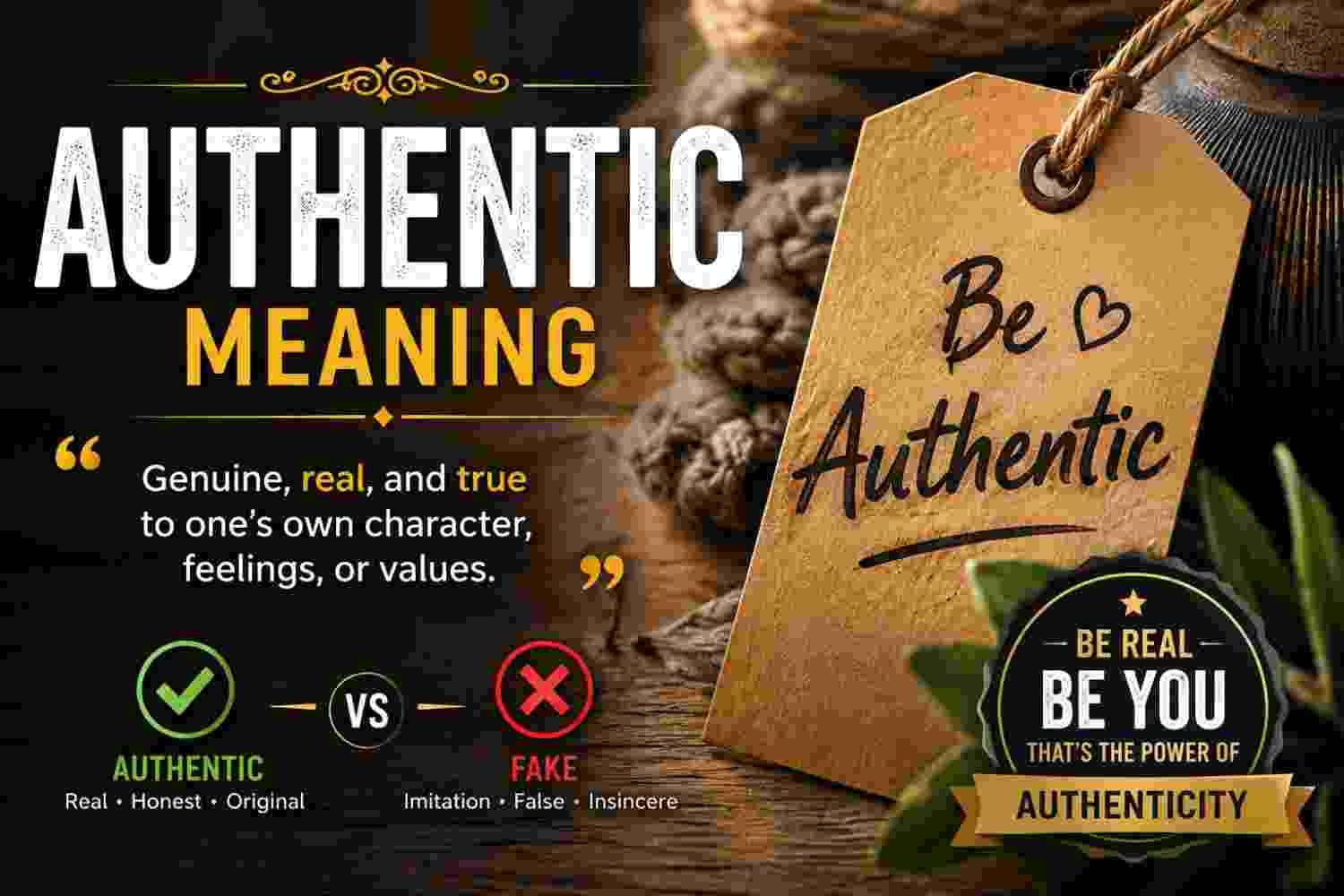
Authentic meaning is the sense of purpose and ease that comes when your actions, words, and values line up. It means you are not performing a role to earn approval. You are living in a way that feels true even when no one is watching.
Is authentic meaning the same as happiness?
No. Happiness is a temporary emotion. Authentic meaning is a stable sense of alignment. You can feel sad, angry, or lonely and still know you are being real. Chasing constant happiness often creates more inauthenticity than meaning.
Can I be authentic without hurting people?
Yes. Authenticity is not a license to be cruel. It means expressing your truth with respect and timing. You can say no without insulting someone. You can disagree without attacking someone’s character. Real honesty has boundaries.
Why do I feel worse when I first start being authentic?
Because you are breaking an old survival pattern. Your brain treats disapproval as a threat. When you speak plainly and someone frowns, your nervous system may flood with fear. That feeling passes as you collect evidence that honesty does not destroy you.
How do I find authentic meaning if I don’t know who I am?
Start with what you are not. Notice the conversations that drain you, the clothes that feel like costumes, the plans you secretly dread. Your dislikes are breadcrumbs. Follow them backward and your real preferences will start to appear.
Can social media ruin my sense of authentic meaning?
Yes, if it becomes a stage. Social media rewards performance, polish, and constant comparison. To protect your authenticity, follow fewer people, post less often, and ask yourself whether you are sharing to connect or to be validated. Connection builds meaning. Validation chases it away.
The Final Verdict on Living Real
Here is the insider tip nobody sells you: authentic meaning is not found in a grand revelation. It is built in the tiny moments when you stop editing yourself. A plain no. A quiet truth. A habit that matches your words. Those moments feel risky at first, then they feel like oxygen.
You do not need permission to be real. You need practice. Start with one secret from this list today. Tell one small truth, skip one fake yes, or sit with one honest feeling. That is how the gap starts closing. That is how authentic meaning stops being a phrase and becomes your life.