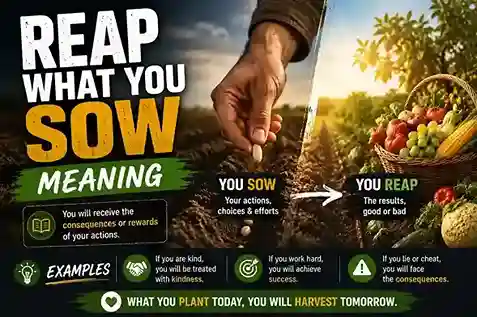
What Does “Reap What You Sow” Mean? (Deep Meaning & Origin)
You keep hitting the same frustrating walls. Your kindness gets ignored, your hard work goes unnoticed. Why does life feel so unfair? The old truth is simple: you always harvest what you plant. Understanding the deep reap what you sow meaning will finally show you how to change your outcomes and attract real success.
This principle isn’t a dusty proverb. It’s an active, unbreakable law that governs your health, your money, your relationships, and your inner peace. When you truly grasp the reap what you sow meaning, you stop blaming luck and start taking ownership. Let’s walk through exactly how this ancient wisdom works in modern life—and how you can use it to build a future you actually want.
What Does “Reap What You Sow” Really Mean?
At its core, the reap what you sow meaning points to the direct link between actions and consequences. If you plant apple seeds, you get apples. If you plant thorns, you bleed. The phrase describes a universal law of return: every thought, word, and deed sets a cause in motion, and the effect will match its nature.
Farmers don’t dig up radishes after scattering corn kernels. Likewise, you can’t scatter dishonesty and expect trust to bloom. This isn’t about punishment. It’s about alignment. The harvest always mirrors the seed. Understanding the reap what you sow meaning strips away the myth that you can behave poorly and magically land a beautiful life.
The Ancient Origin of This Powerful Proverb
The reap what you sow meaning traces back thousands of years, long before it appeared in religious texts. Ancient agricultural societies understood that survival depended on this law. Empty fields taught louder than any sermon.
Many cultures wrapped the concept in their own sayings. The Greeks spoke of fate woven by your own hands. Eastern traditions embedded the idea in karma—the sum of a person’s actions deciding their future. The actual English proverb “as you sow, so shall you reap” took root in the soil of everyday farming life, passed down orally until it became embedded in written language. By the time the phrase landed in sacred scripture, it was already a bone-deep human truth.
The Biblical Foundation: Galatians 6:7 Explained
For millions, the reap what you sow meaning is forever tied to a single verse. The Apostle Paul wrote in Galatians 6:7, “Do not be deceived: God cannot be mocked. A man reaps what he sows.” This statement hits with unflinching clarity.
Paul’s audience lived close to the land, so the metaphor needed no explanation. He was addressing a spiritual principle: you can’t fool the natural order. If you sow to please your selfish desires, you harvest corruption. If you sow to nurture your spirit, you reap life and peace. The full biblical context (Galatians 6:7-9) doesn’t stop at warning—it offers hope. It urges you not to grow weary in doing good, because a harvest will come at the proper time if you don’t give up. (Source: The Holy Bible, Galatians 6:7-9)
The Universal Law of Sowing and Reaping
Strip away religion, and you’re left with a cold, beautiful law. The reap what you sow meaning sits at the center of what many call the Law of Sowing and Reaping. This law operates with seven observable rules:
- You must sow to reap. Nothing grows from an empty hand.
- You reap what you sow. The harvest matches the seed—always.
- You reap later than you sow. Time separates planting from harvest.
- You reap more than you sow. A single seed multiplies.
- You reap in proportion to your sowing. Scatter generously, gather generously.
- You reap the full harvest of the seed. Good seed yields good; bad seed yields destruction.
- You can’t uproot a wrong seed, but you can sow new ones. Fixing the future starts now.
When you internalize these rules, the reap what you sow meaning becomes your greatest strategic advantage. You stop expecting corn from weeds.
How Reaping and Sowing Works in Daily Life
The reap what you sow meaning isn’t reserved for grand moral dilemmas. It pulses through your ordinary Tuesday. Every small choice—what you eat, how you speak to your spouse, whether you hit snooze or lace up your shoes—drops a seed into tomorrow.
The Table of Daily Sowing and Reaping
| Area | Seed You Plant | Expected Harvest |
|---|---|---|
| Physical Health | Daily movement, whole foods, quality sleep | Energy, strength, clear mind, longevity |
| Mental Health | Gratitude practice, boundary-setting, therapy | Emotional resilience, peace, self-respect |
| Finances | Consistent saving, skill-building, avoiding debt | Financial freedom, opportunities, security |
| Career | Showing up early, over-delivering, learning constantly | Promotions, respect, fulfilling work |
| Relationships | Active listening, honesty, small acts of service | Deep trust, loyalty, genuine connection |
| Spiritual Growth | Meditation, prayer, reading wisdom literature | Inner calm, purpose, unshakable hope |
| Self-Education | Reading daily, taking courses, seeking mentors | Sharp thinking, adaptability, career acceleration |
This table turns the reap what you sow meaning into a practical playbook. If your harvest tastes bitter, trace it back to the seed. Then plant something better right now.
Real-Life Examples That Prove the Principle
Concrete examples burn away abstraction. Here are three clear windows into the reap what you sow meaning in action.
The Patient Investor
A young professional invests 10% of every paycheck into a low-cost index fund for twenty years. The market dips, but she keeps sowing. After two decades, compound growth has multiplied her money far beyond her total contributions. She harvested financial independence because she sowed consistency and patience.
The Neglectful Friend
A man consistently cancels plans, forgets birthdays, and only calls when he needs a favor. Over time, his friends stop inviting him. He feels lonely and blames others. In reality, he reaped exactly what he sowed—neglect produced isolation.
The Generous Mentor
A retired teacher volunteers twice a week to tutor struggling students, expecting nothing in return. Years later, former students credit her with changing their lives, and a grateful community surrounds her with care in her old age. She sowed generosity and reaped a legacy of love.
These stories confirm the reap what you sow meaning isn’t a threat. It’s a promise. Good seeds bear good fruit.
Why People Misunderstand the Sowing and Reaping Process
One loud objection always arises: “Good people suffer, and bad people thrive. So the reap what you sow meaning is false.” That frustration carries a grain of truth, but it misunderstands the timeline.
Harvests don’t arrive overnight. A farmer doesn’t panic because the corn didn’t sprout by Tuesday. The law operates over seasons, not seconds. On the surface, a dishonest businessman might drive a luxury car while an honest worker rides the bus. Look closer. The cheat often reaps broken relationships, paranoia, and inner emptiness. The honest worker reaps deep sleep, self-respect, and genuine love. The full harvest isn’t always visible from the curb.
Another misunderstanding: people think they can sow one massive good deed and erase years of destructive patterns. You can’t. A single sunflower seed won’t choke out a field of thistles. Yet you can begin relentlessly planting good seeds today. The reap what you sow meaning rewards direction, not perfection.
The Science and Psychology Behind Cause and Effect
Modern psychology backs the ancient reap what you sow meaning with hard data. The principle closely mirrors the concept of self-fulfilling prophecy and locus of control.
Individuals with an internal locus of control believe their actions shape their destiny. They act more, achieve more, and report greater life satisfaction. Those with an external locus feel powerless, wait for luck, and often confirm their own bleak outlook. Dr. Julian Rotter’s landmark research on locus of control showed that taking ownership (sowing intentional effort) directly alters outcomes. (Source: Rotter, J.B. “Generalized expectancies for internal versus external control of reinforcement,” Psychological Monographs, 1966)
Additionally, the philosophy of “The Law of the Harvest” found its way into personal development through Stephen Covey. In The 7 Habits of Highly Effective People, Covey stressed that you can’t cram on the farm—there’s no shortcut to a harvest. You must sow the right habits, then let nature work. (Source: Covey, Stephen R. The 7 Habits of Highly Effective People)
So the reap what you sow meaning isn’t magic. It’s the psychological reality of patterned behavior yielding patterned results.
Reap What You Sow in Relationships
Relationships magnify the reap what you sow meaning because two people constantly exchange seeds. Every interaction deposits trust or withdrawal slips.
How to Sow Love That Lasts
- Sow attention. Listen without checking your phone. That seed grows connection.
- Sow appreciation. Verbalize gratitude daily. Appreciation reaps emotional safety.
- Sow forgiveness. Release small grudges quickly. Mercy harvests freedom.
- Sow vulnerability. Share your fears. Courage breeds intimacy.
If you sow criticism, you harvest resentment. If you sow silence, you harvest distance. If you sow kindness, you harvest a fortress of loyalty. The reap what you sow meaning gives you total control over the climate you create in your home.
How to Plant Good Seeds for a Better Future
Armed with the full reap what you sow meaning, you can engineer a stunning future. This isn’t wishful thinking. It’s a discipline.
1. Get honest about your current harvest.
Look at your bank account, your body, your closest relationships. Write down what you see. That’s your harvest. No shame—just data.
2. Identify the seed behind the harvest.
A struggling marriage points to seeds of neglect or harsh words. A thriving career points to seeds of skill-building and reliability. Connect the dots without flinching.
3. Choose three new seeds to plant today.
Pick specific actions. “I will drink water before coffee.” “I will write one thank-you email.” “I will walk for 20 minutes.” Small seeds are non-negotiable.
4. Protect your field.
Remove weeds. That means limiting negative media, toxic relationships, and self-sabotaging habits. Guard what you allow into your mind.
5. Wait with active patience.
Water the seeds daily. Track your progress. Celebrate small sprouts. The harvest will come. Ralph Waldo Emerson captured the essence perfectly: “The law of harvest is to reap more than you sow.” Believe it.
Common Mistakes That Lead to a Bitter Harvest
Even with the best intentions, people violate the reap what you sow meaning and then wonder why life stings. Avoid these traps.
- Impatience: Digging up the seed to check if it’s growing kills it. Give your good habits time.
- Inconsistency: Sowing kindness on Monday and rage on Tuesday confuses the soil. Consistency compounds.
- Blaming the weather: Markets, pandemics, and other people will always exist. The farmer who blames the sun never plants. Focus on your response.
- Planting for the wrong harvest: Chasing money while ignoring health seeds a net loss. Define your desired harvest first.
- Ignoring the mind’s soil: Your beliefs are the soil. Unhealed trauma acts like toxic ground. Work on inner healing so good seeds can take root.
Powerful Quotes That Capture the Reap What You Sow Meaning
Timeless voices have tried to distill the reap what you sow meaning into sentences that stick. These quotes inspire and correct.
- “Don’t judge each day by the harvest you reap but by the seeds that you plant.” — Robert Louis Stevenson
- “Life is like a garden. You reap what you sow.” — Paulo Coelho (paraphrased sentiment)
- “You cannot sow crabgrass and expect to harvest pineapples.” — Original proverb adaptation
- “The law of harvest is to reap more than you sow. Sow an act, and you reap a habit. Sow a habit, and you reap a character. Sow a character, and you reap a destiny.” — Attributed to Charles Reade and often quoted by Covey
Tape one of these to your mirror. Let the reap what you sow meaning marinate in your daily thoughts.
Turning the Principle Into Your Greatest Advantage
You now understand the reap what you sow meaning deeper than most people ever will. This knowledge is a seed itself. If you merely read and nod, you’ve planted nothing. If you act, you change everything.
Start tonight. Identify one tiny seed you can plant before sleep—a kind text, ten minutes of reading, a short prayer. Wake up and plant another. The compound effect of intentional sowing will explode your life in directions you can’t yet imagine. You are the farmer of your days. No one else holds the seed bag. Plant deliberately, and you’ll reap a life that feels like a gift you earned.
Frequently Asked Questions (FAQs)
What is the simple meaning of reap what you sow?
It means your actions, good or bad, will eventually come back to you as results. The harvest always matches the seed you planted.
Is reap what you sow the same as karma?
They share the same core principle of cause and effect. Karma roots itself in Eastern religions with a focus on reincarnation, while the reap what you sow meaning often stands alone as a practical moral law, heavily emphasized in Christianity through Galatians 6:7.
Where does the phrase reap what you sow originate?
The phrase originated in ancient farming communities as a literal observation of agriculture. It appears in various cultural proverbs and was later cemented in Western thought through the Bible’s New Testament.
How can I apply the reap what you sow meaning to my daily life?
Start by treating every choice as a seed. Choose actions aligned with the future you want—save money, speak kindly, learn skills—and patiently trust the harvest cycle.
What does the Bible say about you reap what you sow?
The Bible explicitly teaches this in Galatians 6:7-9, warning believers not to mock God by sowing to the flesh and expecting a spiritual harvest. It encourages persistent good works, promising a harvest of blessing at the right time.
Can you fix a bad harvest once you’ve sown destructive seeds?
You cannot erase the consequences of past wrong seeds, but you can immediately start planting new, positive seeds. Over time, the new, healthy harvest overshadows the old damage, and the future shifts.